

A property's climate risk — wildfire, flood, hurricane, hail, and more — doesn't show up in a listing photo, and it shapes both ongoing costs and future value. Checking it means looking at three levels: national trend, county exposure, and the property itself. Here's how, using wind and hail as the example — the most common cause of claims nationally.
A listing photo won't tell you a property's climate risk. Neither will the neighborhood's reputation. The risk that actually drives the most insurance claims nationally is one most buyers never think to check before falling for a home.
Why Should You Check a Property's Climate Risk Before Making an Offer?
A property's climate risk isn't one thing. Wildfire, flood, hurricane, extreme heat, wind, and hail all fall under it, and none of them show up in a listing photo, a walkthrough, or a neighborhood's general reputation.
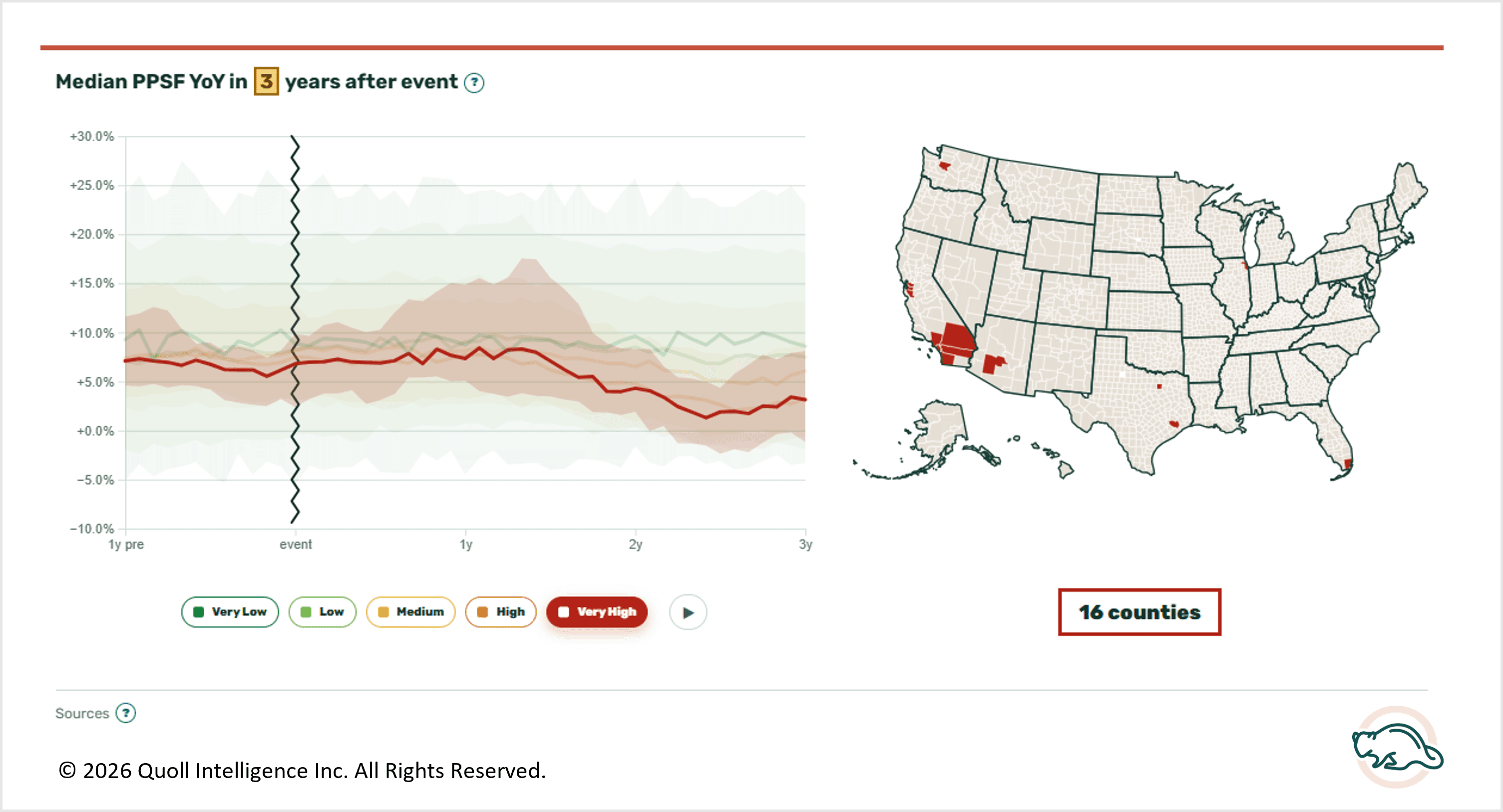
What that risk actually does to a buyer depends on how severe it is. In medium-risk areas, climate risk mainly shows up as a recurring drag on the ordinary costs of owning the home — higher monthly utility bills, more frequent maintenance, rising insurance premiums, and property taxes that climb with reassessments tied to disaster history. It's a cost problem, not a survival problem. In high- and highest-risk areas, the stakes compound in two distinct ways. First, market value itself recovers and grows more slowly after a disaster event — not immediately, but over the years that follow. Second, rising insurance costs can eventually reach a tipping point where they make a home genuinely harder to sell, and in a buyer's market, that usually means the seller has to make concessions, including on price, just to find a willing buyer.
As a real climate risk example, consider wind and hail damage. They're two separate perils — a building can be damaged by wind alone, hail alone, or both — but insurers commonly report and price them together, often with a shared deductible or a separate endorsement required in high-risk areas.
Wind and hail damage is prominent nationally, not regional. About 1 in 35 insured homes files a wind or hail damage claim every year, according to the Insurance Information Institute, and it accounted for 40.7% of all homeowners claims in 2022 — the single largest cause of claims in the country. NOAA recorded 5,432 hail events nationally in 2025, up slightly from 5,373 in 2024. In the highest-risk region — "hail alley," where Colorado, Nebraska, and Wyoming meet — NOAA's Severe Storms Laboratory reports an average of seven to nine hail days a year, not a single isolated event a homeowner might reasonably budget around once and forget.
Unlike a wildfire, a single hailstorm rarely wipes out an entire area, but it does accumulate: repeated, smaller-scale damage, year after year, in a way a one-time catastrophe doesn't. Severe convective storm losses — hail, tornadoes, and straight-line wind combined — exceeded $50 billion nationally for the third consecutive year in 2025. Much of that cost lands directly on homeowners, not just insurers: in many high-risk states, wind and hail carry their own separate, often percentage-based deductible, meaning a homeowner can be paying thousands out of pocket on a claim even with coverage in place.
That combination — frequent, recurring damage and real out-of-pocket exposure — is what eventually shows up in resale. In Colorado, which the Rocky Mountain Insurance Association ranks second nationally for hail insurance claims, one Broomfield, CO homeowner recently described her insurance costs rising by more than $300 a month — the kind of sudden, sizable jump that would make anyone budgeting for a mortgage payment stop and wonder if they could absorb it. Her own words: she'll probably move, specifically because of the cost. That's the buyer-relevant outcome underneath the national statistics — in high-hail markets, rising insurance costs are starting to price out exactly the buyers a current owner would eventually need to sell to.
How Do You Actually Check This for a Specific Property?
A real risk check works at three levels — national trend, county-level exposure, and the property itself — and that's exactly what a usable risk score needs to show.
Here's what that looks like in practice, using a real Jefferson County, Colorado home as the example. At the national level, the picture is what's described above: wind and hail as the leading cause of claims, thousands of events a year, tens of billions in losses. At the county level, the same data narrows to a specific place — how this particular county's hail exposure compares to the rest of the country, not just a general sense that "Colorado has hail." At the property level, it narrows again to the actual home under consideration: its specific location, its specific exposure, not a county-wide average applied to every address in it.
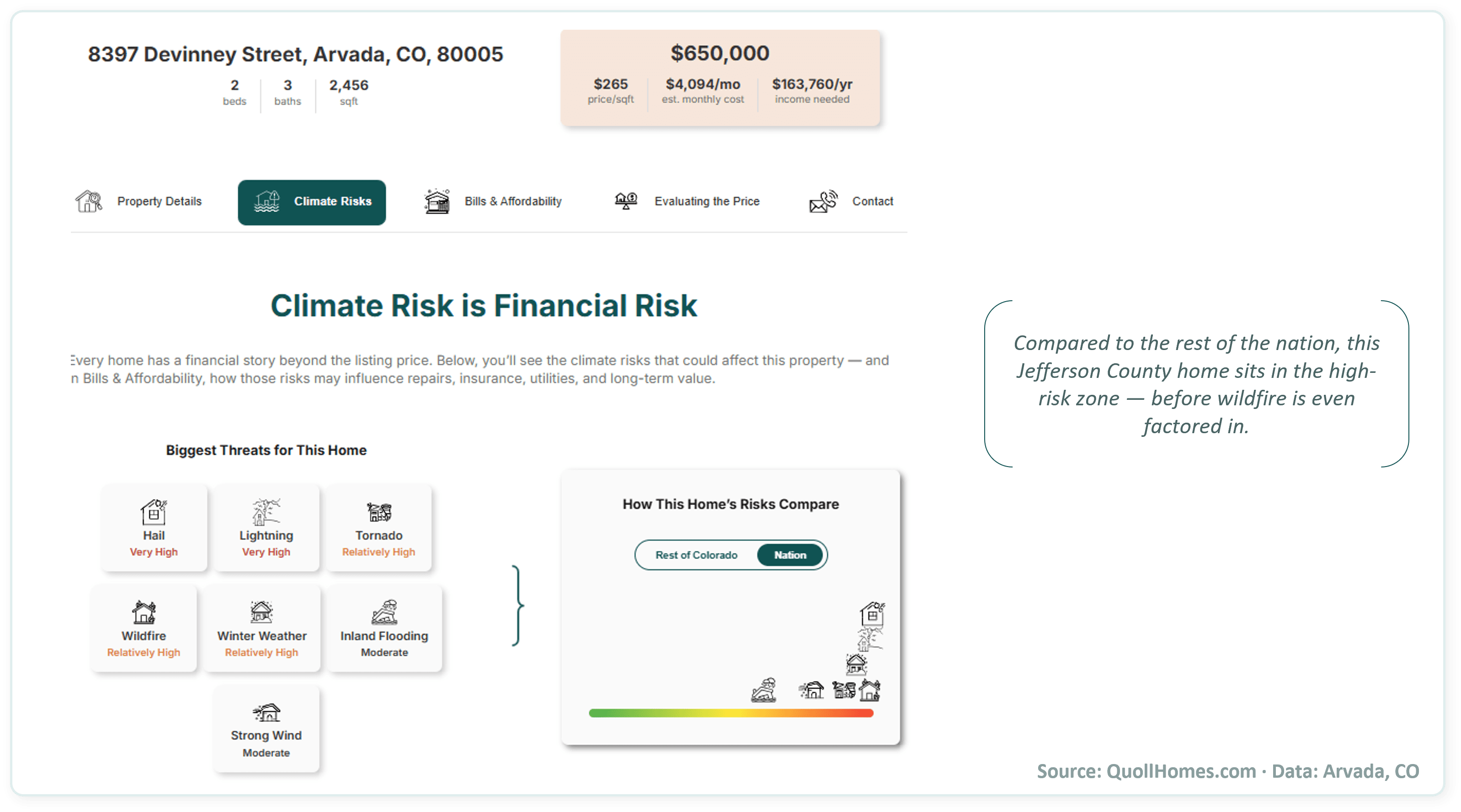
It's important to understand this, regardless of which property or which peril: national context, narrowed to county, narrowed to address. A property in a low-hail state can still carry real wind/hail exposure at the county or address level, and a property in a high-risk state can still be a reasonable bet if its specific address checks out. The three-level check is what tells the difference — a state-level assumption alone can't.
How Do You Run This Check on a Home You're Actually Considering?
A buyer doesn't have to piece this together from multiple sources — a property's climate risk score does this drill-down automatically, before an offer is made.
QuollHomes.com shows this same national-to-property breakdown for any specific address being considered — not just wind and hail, but the fuller climate risk picture for that property, generated before an offer, not discovered after.
Search your target market at QuollHomes.com.
Frequently Asked Questions
Why does wind and hail account for so many home insurance claims?
Wind and hail damage is common, widespread, and happens far more frequently than other climate perils — NOAA recorded over 5,400 hail events nationally in 2025 alone, and it's the single largest cause of homeowners insurance claims as a result.
Is this only a risk in certain states, like Texas or Colorado?
No. Wind and hail damage happens nationally — over 5,400 hail events were recorded in 2025 alone, spread across states from Texas and Kansas to the upper Midwest. Colorado is a genuinely high-risk state (it ranks second nationally for hail insurance claims), but it's one example among many, not the exception that proves the rest of the country is safe.
How can I check a specific property's climate risk before I make an offer?
Look at three levels: the national trend for the relevant peril, the county-level exposure, and the property's specific risk. QuollHomes.com shows this breakdown for any address you're considering, before you make an offer.
Read next: Is Climate Risk Now a Bigger Price Factor Than Interest Rates? · What "Home Insurance Deserts" Are · How Rising Insurance Costs Are Quietly Changing Mortgage Qualification
Sources: Insurance Information Institute (Triple-I), "Facts + Statistics: Hail" and "Facts + Statistics: Homeowners and Renters Insurance" · NOAA National Weather Service Storm Prediction Center Annual Severe Weather Report Summary (via Triple-I) · NOAA National Severe Storms Laboratory, "Severe Weather 101: Hail Basics" · Insurify, "Homeowners Insurance Facts and Statistics" (2026) · Quoll proprietary research, county-level housing market response to extreme climate events (16 counties) · CBS Colorado, reporting on Rocky Mountain Insurance Association data (Broomfield homeowner example)