

Climate risk may now be a bigger factor in some housing markets than mortgage rates. In Hillsborough County, FL, prices and rates have both leveled off, yet days on market have climbed from 8 in 2021 to 63 by early this year — as buyers factor in climate-driven insurance costs before they ever make an offer.
Every affordability headline points to the same villain: mortgage rates. But in at least one market, rates aren't moving much anymore, prices haven't spiked, and buyers are still walking away in numbers that keep climbing. Something else is driving the slowdown, and it's been hiding in plain sight.
What's Actually Happening in a Market Where Prices and Rates Both Look Normal?
Hillsborough County prices are stable, and mortgage rates — after rising sharply earlier in the decade — have leveled off. Neither one explains what's happening to this market.
Start with rates. The 30-year fixed averaged 2.96% in 2021, then rose fast: 5.34% in 2022, 6.81% in 2023, per Freddie Mac's Primary Mortgage Market Survey. Since then, it's barely moved — 6.72% in 2024, 6.60% in 2025, and holding fairly steady since. Whatever's driving Hillsborough's slowdown, it isn't a rate story from the last two years, since rates have been essentially flat over that stretch.
Prices aren't the story either. The median home in Hillsborough County still sells for $415,000 — within reach for plenty of households, and not meaningfully different from where it's been.
What has changed is how long it takes to sell one. In 2021, a Hillsborough County listing spent a median of 8 days on the market before going under contract. By January of this year, that number had climbed to 63 — nearly eight times longer. Sellers are feeling it too: the sale-to-list price ratio has fallen below 97%, meaning buyers are consistently negotiating below asking in a market that still commands a $415,000 median price.
None of that lines up with a rate story or a price story. It lines up with something buyers are learning about these specific homes before they're willing to commit.
Why Are Buyers Walking Away From Homes They Can Technically Afford?
Six FEMA-declared major disasters have hit Hillsborough County since September 2022, and the insurance costs that followed are driving buyers to reconsider deals they'd otherwise be ready to close — a pattern that isn't unique to Florida.
Hurricane Ian struck first, in September 2022, followed by Hurricane Nicole that December. Hurricane Idalia hit in August 2023. Hurricane Debby and Tropical Storm Helene were declared as two separate disasters six weeks apart in 2024, and Hurricane Milton closed out that year in October. That's six declared disasters in roughly two years, not one single bad season. Each cluster landed at a point where the market might have been expected to stabilize. Instead, days on market kept climbing and sale-to-list price kept falling.
Part of the driver for this is insurance, and Florida's own regulator has the numbers. The statewide average homeowners premium rose from $2,798 in May 2022 — right after the legislature's first reform package — to $3,748 by September 2025, a 34% increase in a little over three years, according to Florida's Office of Insurance Regulation. That's not a number most buyers see on the listing. It's a number they discover during due diligence, if they discover it at all before they're already deep into a deal.
The pace has slowed more recently — OIR reports insurers filed for rate decreases 73 times and for flat, 0% increases 94 times in the months following Hurricanes Helene and Milton — but that's relief from a much higher base that doesn't reverse the run-up itself.
This isn't unique to Florida — it's a recognizable pattern wherever a disaster of this scale hits. California saw the same thing play out in its worst wildfire years: in the state's highest-risk ZIP codes, insurers paid out more in claims than they'd collected in premium, the same underlying math showing up through a different peril. Coverage gets harder to find afterward, premiums climb further for whoever's left, and the properties in those ZIP codes keep appreciating, just more slowly than they would without that pressure sitting on top of them.
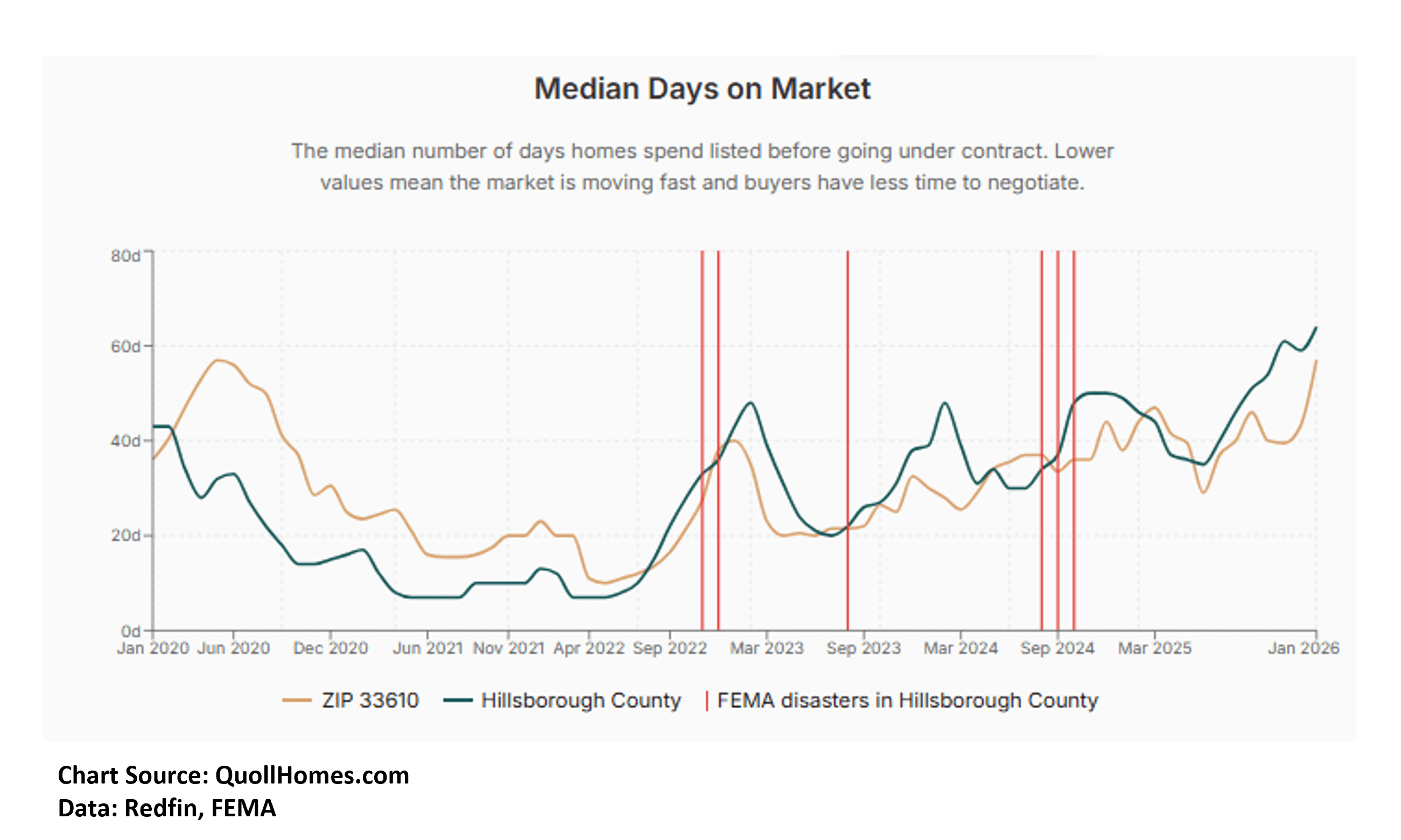
The chart makes the overlap hard to miss: every surge in days-on-market lines up with a storm cluster, not a rate move.
How Do You Avoid Learning This the Way Hillsborough Buyers Did?
The cost curve driving Hillsborough's slowdown is knowable in advance — on a specific property, before you ever tour it or make an offer.
Right now, most buyers learn it the slow way: they fall for a home, make an offer, and discover the real number during inspection, insurance shopping, or a renegotiation after appraisal. That's what's showing up in Hillsborough's falling sale-to-list ratio — deals getting renegotiated down once the full picture becomes clear.
QuollHomes.com shows that number upfront. Every listing includes the estimated monthly cost of actually owning that home — mortgage, insurance, property taxes, and utilities — along with a 10-year climate risk projection specific to that property. Not a county average. Not something you find out three weeks into a deal.
And because insurance costs don't move in a straight line — Florida swung from a 33% single-year jump to a near-standstill within the space of about four years — a single projected number wouldn't tell the whole story either. QuollHomes.com's affordability tool lets you input the insurance increase you actually want to model — a conservative one, an aggressive one, whatever you think is realistic for a specific property — and see how the full cost curve shifts as a result, instead of betting everything on one projection.
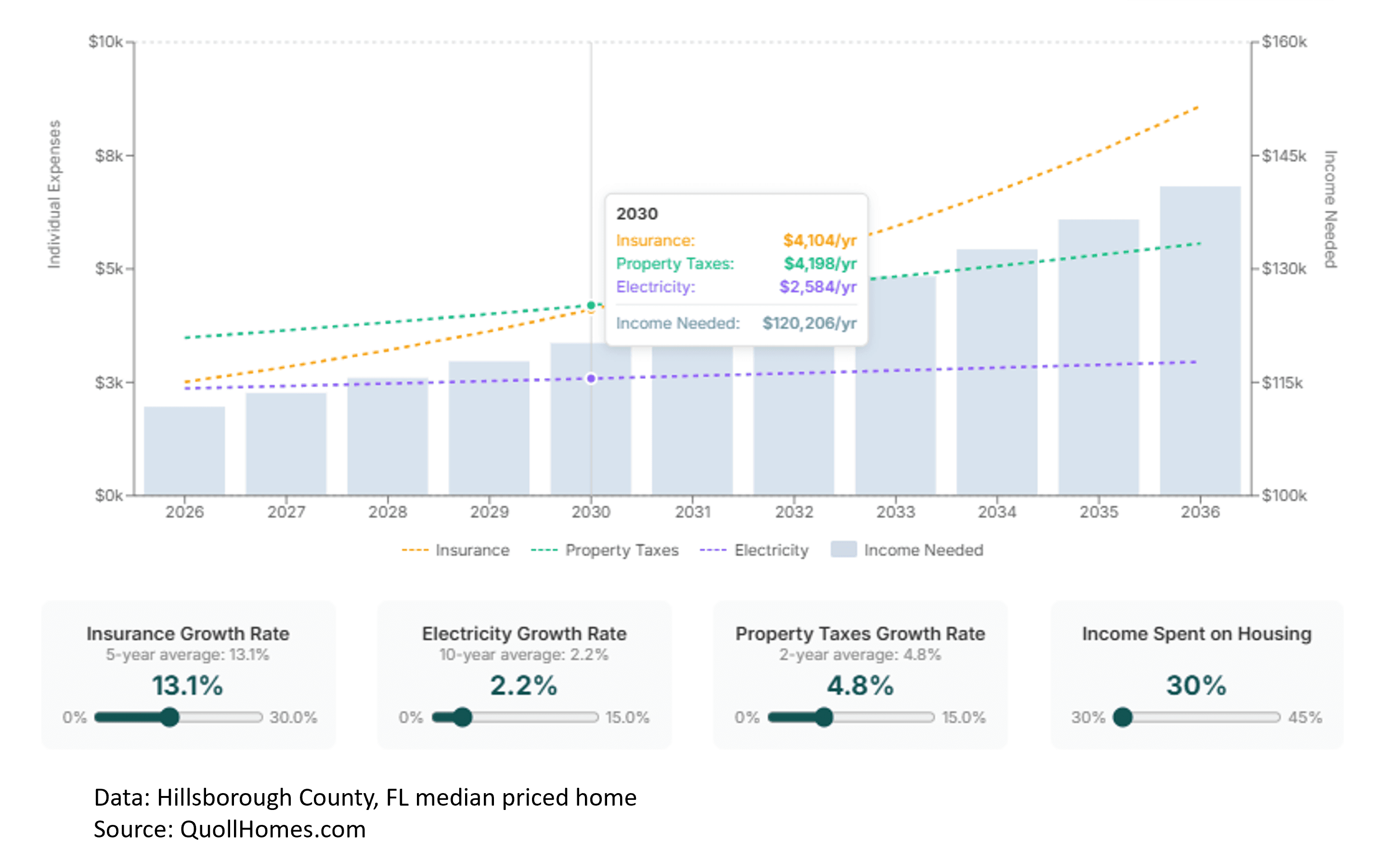
See what this looks like on a real listing at QuollHomes.com.
Frequently Asked Questions
Is climate risk really a bigger factor than mortgage rates right now?
In markets like Hillsborough County, the evidence points that way. Rates have been essentially flat for the past two years, and prices haven't moved much either — but buyer behavior has changed dramatically, tracking storm activity and insurance costs rather than the rate environment.
Why are homes in Hillsborough County taking longer to sell if prices haven't changed?
Days on market climbed from 8 in 2021 to 63 by early this year because buyers are increasingly factoring in the full cost of ownership — especially climate-driven insurance costs — before committing, not just the listing price.
Is this happening outside Florida too?
Yes — it's a recognizable pattern wherever a disaster of this scale hits. California saw the same thing play out in its worst wildfire years: insurers in the state's highest-risk ZIP codes paid out more in claims than they'd collected in premium, the same underlying math showing up through a different peril.
How can I check a specific home's climate risk before making an offer?
QuollHomes.com shows a 10-year climate risk projection and estimated monthly cost of ownership for any specific property, before you make an offer.
Read next: Home Insurance Deserts · How to Read a Property's Climate Risk Score Before You Fall in Love With It · Attainability Fatigue
Sources: Freddie Mac Primary Mortgage Market Survey (via Bankrate, PennyCalc compiled series) · Redfin · FEMA disaster declarations · Florida Office of Insurance Regulation (via Florida Realtors reporting) · Terner Center / Insurance Information Institute (CA wildfire loss-ratio data)