
A state FAIR plan is a state-run insurer of last resort, not an automatic fallback — availability depends on the property, and coverage is usually limited to specific perils like wind, hail, or wildfire. Before buying, confirm the home can get coverage at all, check exactly what's covered, and price the cost into your budget. Flood is a separate track entirely.
You're deep into a home search — maybe already picturing yourself in the kitchen — when an agent or an insurance quote comes back with something unexpected: this property is only insurable through the state's FAIR plan. It's tempting to hear that as an automatic dealbreaker. It isn't one by default, but it does mean there's real homework to do before you can trust the numbers you're working with.
What Is a State FAIR Plan, and Why Would a Home Need One?
A FAIR plan is a state-created insurer of last resort. It exists because private insurers have already pulled back from covering certain properties or regions — the plan is a response to that retreat, not a comment on anything unusual about one specific house.
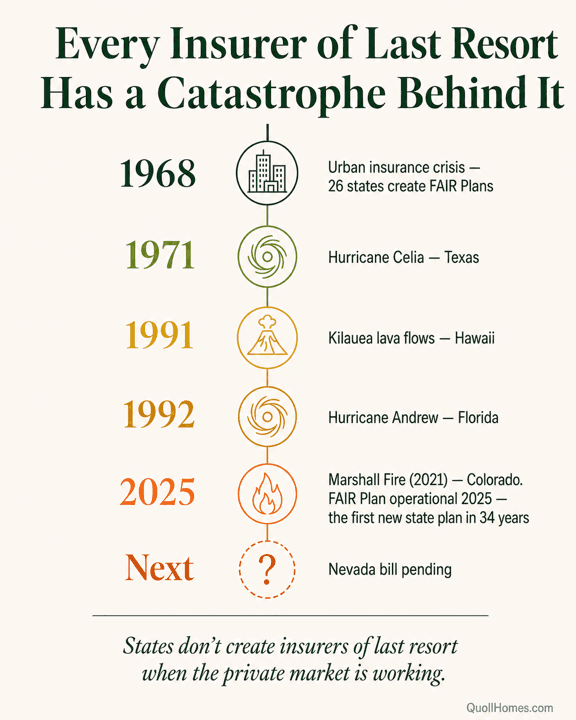
The pattern shows up across decades and states. Texas created the Texas Windstorm Insurance Association (TWIA) in 1971 after private wind coverage became hard to find along the coast. Hawaii's Property Insurance Association followed in 1991. Florida's Citizens Property Insurance Corporation was formed in 2002 by merging two insurer-of-last-resort programs the state had created in the 1990s after Hurricane Andrew's private-market collapse — Andrew alone drove more than a dozen insurers into insolvency. More recently, Colorado's FAIR Plan — created by HB23-1288, signed into law in 2023 and opened to applicants in 2025 — gained urgency after the Marshall Fire exposed how thin private wildfire coverage had become in parts of the state.
What Does a FAIR Plan Actually Cover — and What Doesn't It?
Most state FAIR plans cover a narrow set of weather perils — commonly wind, hail, or wildfire. According to the Insurance Information Institute (III), each state's plan is generally built around whichever peril is most common there: California's FAIR Plan centers on brush and wildfire risk, while New York's and Georgia's plans focus on wind and hail coverage for their highest-risk coastal communities. A handful of states go further — Ohio offers a genuinely comprehensive homeowners option alongside its basic fire coverage — while others, like Pennsylvania and West Virginia, limit their plans to fire and lightning only. Hawaii's program is a useful reminder that FAIR-style plans aren't always about wind or fire at all: the Hawaii Property Insurance Association, established in 1991, exists specifically to cover volcanic activity in the lava zones of Hawaii Island. The takeaway holds regardless of the specific peril: what a FAIR plan actually covers has to be checked state by state, never assumed from another state's plan.
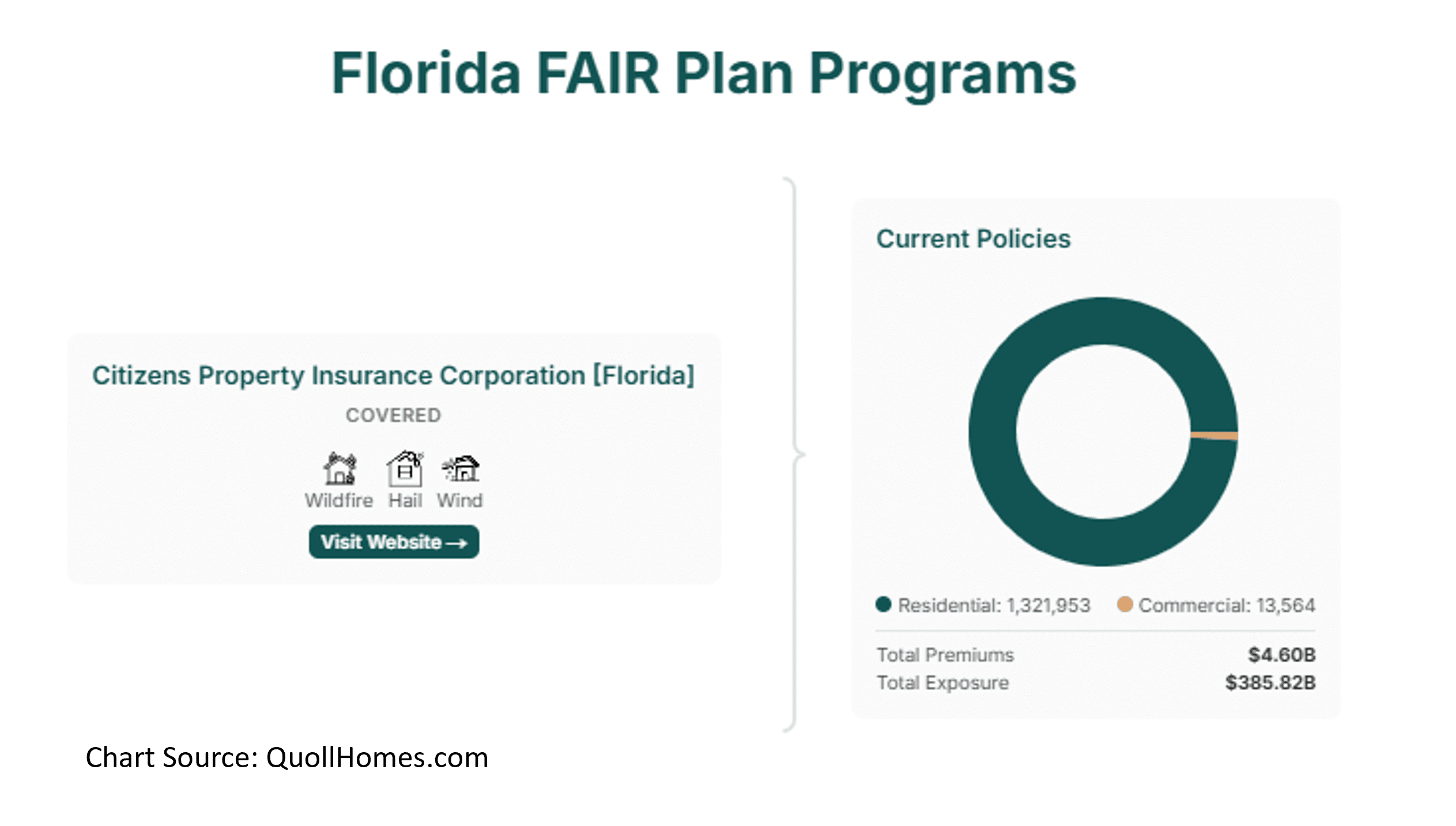
Quoll's coverage data makes this concrete. Florida's Citizens Property Insurance Corporation, one of the country's largest FAIR plans, currently covers wildfire, hail, and wind for its policyholders — 1,321,953 residential policies and 13,564 commercial policies, representing $4.60 billion in total premiums against $385.82 billion in total exposure.
One peril that's missing from that list, and from almost every FAIR plan, is flood. FEMA doesn't hedge on this: standard homeowner coverage generally stops well short of flood damage, and covering it takes a policy of its own — typically the National Flood Insurance Program (NFIP) or a private flood insurer. FAIR plans don't fill that gap either — TWIA's FAQ makes the boundary explicit, noting that its policies exist to solve the wind-and-hail problem, not the flood one. If a property carries real flood exposure, a FAIR plan solving the wind or wildfire problem doesn't solve that one — flood coverage sits on a completely different track, regardless of which insurer handles the rest.
How Do You Know If You Can Afford FAIR Plan Coverage Before You Buy?
The sequence matters more than any single fact here. Work through it in order:
Identify the property's biggest climate risks. Pull an actual risk report for the specific address rather than relying on a general "hurricane state" or "wildfire state" label — it breaks exposure out by peril (wildfire, wind, hail, flood, and so on), and that peril-level detail is what makes the next three steps meaningful instead of guesswork.
Check insurance availability and whether a standard policy covers those specific perils. Get quotes from more than one carrier — availability varies insurer by insurer, not just state by state. California's insurance regulator has documented major insurers pulling back from writing new business in specific high-risk ZIP codes well before pulling out of a state entirely, so a carrier can still be active in the area while declining a given property. Ask each one directly whether the policy covers the specific peril identified in step 1, rather than asking about "insurance" in general; a standard policy can technically exist while still excluding or capping the one risk that actually matters for that property.
If a standard policy doesn't cover the risk, check whether the state FAIR plan covers it. Go back to the peril-by-state pattern from the previous section — don't assume a FAIR plan covers what's needed just because one exists in that state. Most state FAIR plan associations list their exact covered perils and coverage limits directly on their own websites, and an agent who's placed FAIR plan policies before can usually confirm it in a single call.
If FAIR coverage is available and necessary, price it into your budget. Get an actual quote rather than estimating — FAIR plan premiums vary widely by state and by peril, and most states require documented proof of prior denials from private carriers before an application is even accepted (Colorado's program, for example, requires rejection by three separate insurers first), which adds real time to a purchase timeline. FAIR plan premiums typically run higher than standard market rates, and enrollment has been climbing as private insurers retreat further. Stanford research published in 2026 found California homeowners insurance premiums up 84% since 2020, with FAIR Plan enrollment nearly tripling — from under 2% to 5% of homes — over the same period.
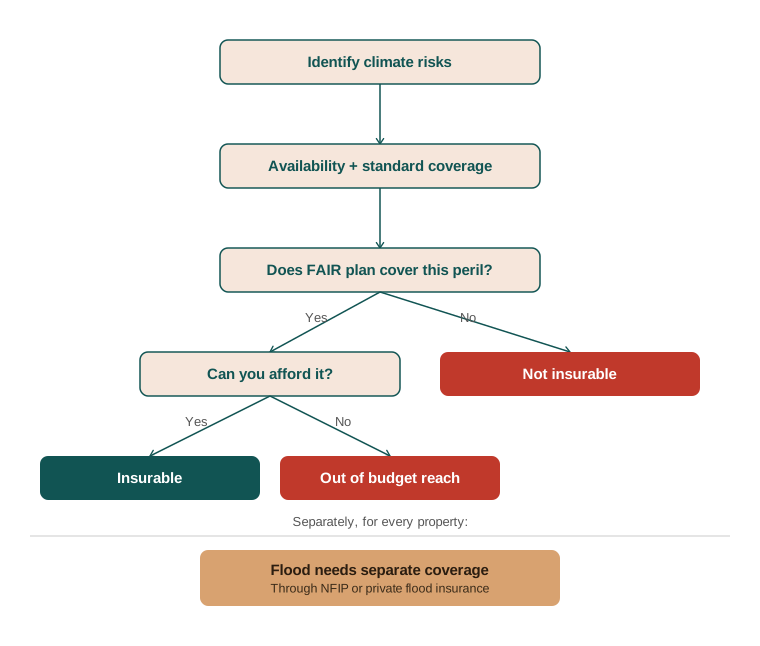
Skipping straight to "can I get any insurance at all" without going through steps 1–3 first is how buyers end up with a policy that technically exists but doesn't actually cover the risk they were worried about in the first place.
Frequently Asked Questions
What is a state FAIR plan?
A FAIR (Fair Access to Insurance Requirements) plan is a state-created insurer of last resort. It provides basic property coverage to homeowners who can't find a private insurer willing to write a policy, usually because of concentrated risk in that area.
Why would a house only qualify for insurance through a state program instead of a regular insurer?
Private insurers sometimes pull back from writing new policies in areas where they've priced in heavy losses from wind, hail, wildfire, or other perils. When that happens, a FAIR plan steps in as the fallback option so homes in that area can still get basic coverage.
Does a FAIR plan cover flood damage?
Usually not. Flood coverage is excluded from most FAIR plans, the same way it's excluded from standard homeowners policies. It's handled separately through the National Flood Insurance Program or a private flood insurance policy.
Can you get a mortgage on a home that's only insurable through a FAIR plan?
Often yes, as long as the FAIR plan coverage meets the lender's requirements and you can document it before closing — but it's worth confirming with your lender early, since FAIR plan policies can come with different terms and higher premiums than a standard policy.
What to Do Next
Search homes for sale at QuollHomes.com to see the climate risks a property actually faces and whether the state has a FAIR plan that could help cover the biggest threats to it. Then take that specific list to your agent and ask directly: does a standard policy cover these risks, and if not, what would FAIR plan coverage cost here?
Related reading:
Home Insurance Deserts — internal link pending, not yet live
Underwriting details that affect insurance quotes — internal link pending, not yet built