
A "hot" market's price already reflects its growth — that's priced into your mortgage either way. Whether that's the only cost or the first of two depends on the property's climate risk: in high-risk markets, insurance and other recurring costs are still catching up, landing on top of an already-elevated price.
Realtors and headlines both use the word "hot" to describe a market's price trend. Neither one is describing the property under consideration, or what it will actually cost to keep.
Does a Hot Market's Price Already Include Its Risk?
No. A market's price reflects demand and appreciation, not the climate exposure sitting underneath it. A market becomes "hot" because buyers have already bid the price up — that's a demand signal, and it says nothing about the risk a specific property carries.
Eight markets make this easy to see side by side: Hillsborough County, FL; Lee County, FL; Maricopa County, AZ; Travis County, TX; Erie County, NY; Marion County, IN; Dane County, WI; and Larimer County, CO. Home prices in these markets grew anywhere from 85% to 137% between 2015 and 2024, according to the Federal Housing Finance Agency's House Price Index — a wide range, driven by very different stories, from Sun Belt migration to a quiet college-town market to a Rocky Mountain foothill town.
The risk side of the same eight markets doesn't spread out anywhere close to that widely. Using FEMA's Resilience Analysis and Planning Tool, each market's dominant hazard — hurricane in the two Florida counties, heat wave in Phoenix, tornado in Austin and Indianapolis, winter weather in Buffalo, cold wave in Madison, lightning in Fort Collins — scores "Very High" nationally, clustered between 98.98 and 100 on FEMA's 0–100 scale.
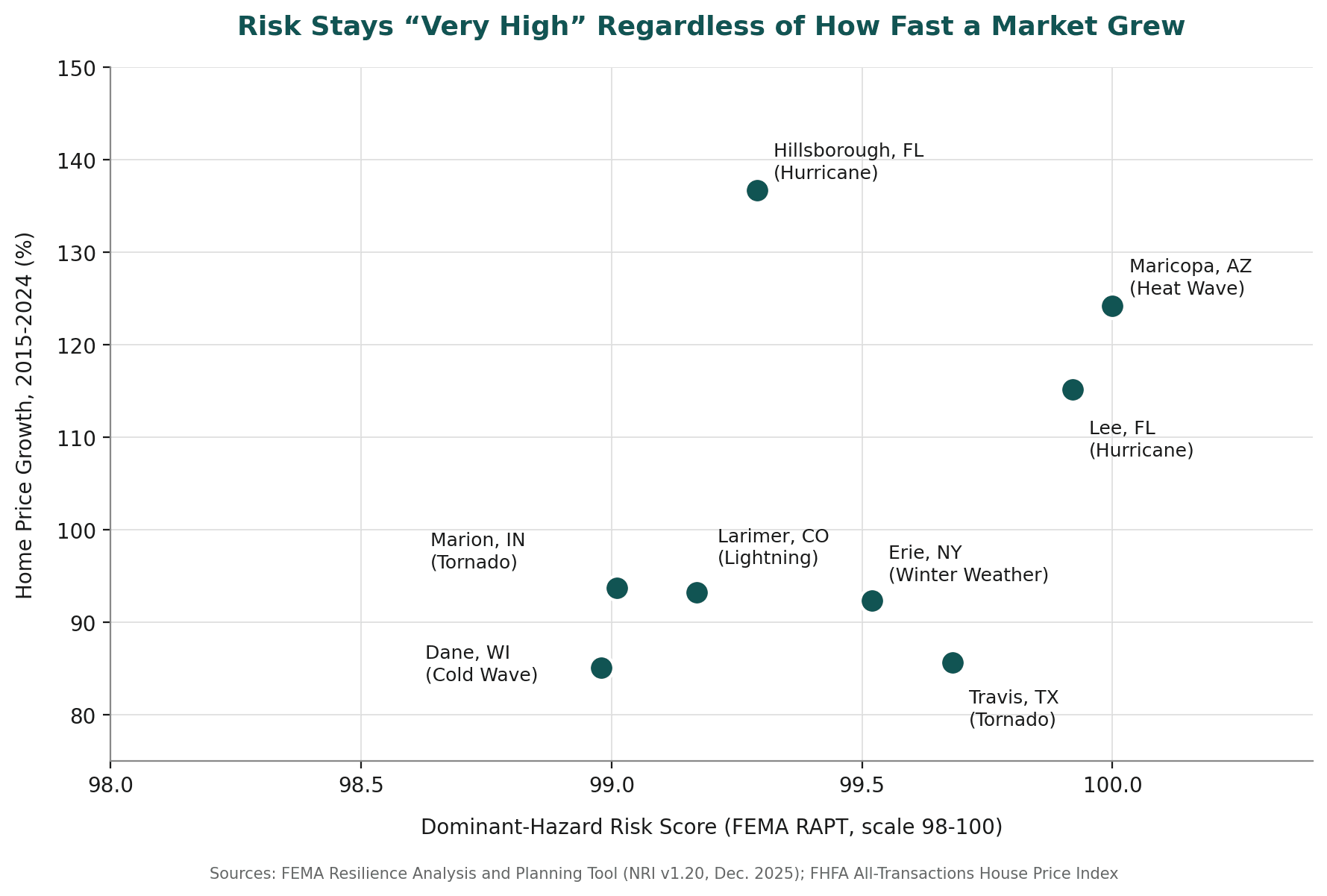
Growth ranged widely. Risk didn't. A market growing 85% over that decade carries essentially the same severity of risk, on its own terms, as a market growing 137%. Whatever a "hot market" headline is telling a buyer, it isn't telling them how risky the specific property is.
Why Doesn't the Market's Price Warn You About the Risk?
Because price and risk move on different clocks. A market's price responds to today's buyers and sellers. Insurance costs respond to claims history and reinsurance pricing, and insurers only reprice once that data forces them to — which can trail a market's price run-up by years.
That lag shows up directly in how these eight markets have cooled since their 2021–2022 pandemic-era peak. Lee County, FL, in a state where the cumulative homeowners insurance rate increase from 2019–2024 was 55%, per LendingTree's State of Home Insurance: 2025 report, saw the steepest deceleration of the eight — a 31.8-percentage-point drop from its 2021–2022 growth rate to its 2023–2024 rate. Erie County, NY, in a state where insurance costs rose a comparatively modest 21.7% over the same period, decelerated by only 8.3 points.
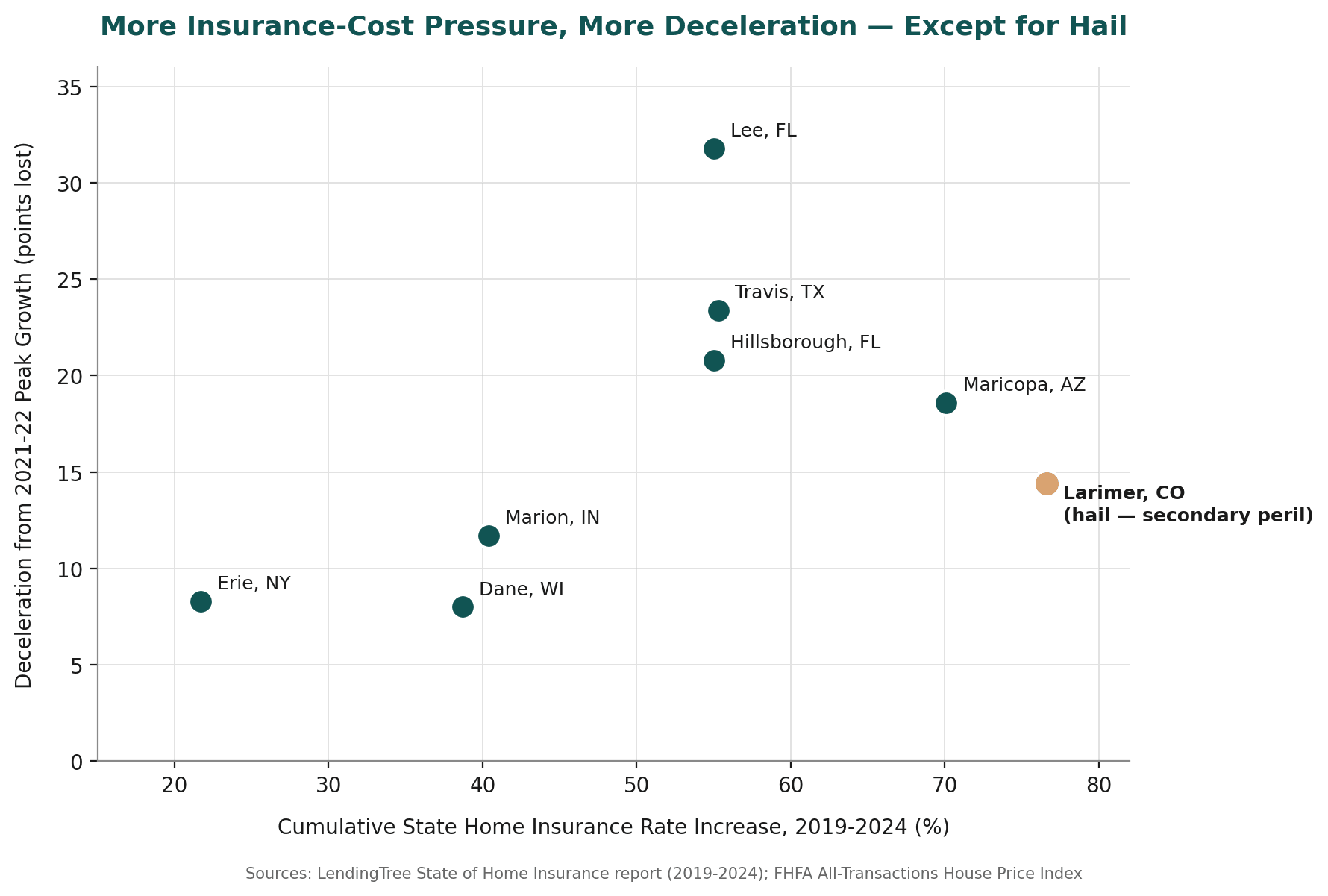
The pattern holds for seven of the eight markets: more state-level insurance-cost growth, more deceleration. The exception, Larimer County, CO, is worth naming rather than smoothing over. Colorado's 76.6% cumulative insurance increase is the highest of any state in the country, yet Larimer's deceleration (14.4 points) sits closer to the middle of the pack than the top. Larimer's practical insurance-cost driver is hail, and hail has long been classified by the insurance industry as a "secondary peril" — a real term, from Swiss Re Institute — meaning high in frequency but historically lower in severity per event than hurricanes or wildfires. Cotality's 2026 Severe Convective Storm Risk Report shows that gap closing fast, with some hail losses now rivaling a major hurricane's, but the market's reaction may simply not have caught up yet to a peril still shedding its "secondary" reputation.
How Do You Know Which Kind of Hot Market You're Looking At?
Not from the market-level price trend. That number looks identical whether the property behind it is a single-hit situation — an elevated price, nothing more — or a double-hit one, where a rising insurance bill is still catching up to a genuinely high-risk property. A market's headline price can't distinguish between the two. Only a specific property's risk profile can.
That's the actual decision buried inside a "hot market": not whether to pay the premium the growth already created, since the market has already decided that part, but whether that premium is the whole story or just the first half of it.
See a specific address's actual risk profile — not just the market's price trend — at QuollHomes.com.
Frequently Asked Questions
Does a "hot" housing market mean it's overpriced?
Not necessarily. "Hot" describes current demand and price trend, not future value or risk — and the market price doesn't answer the overpriced question either.
Why do insurance costs sometimes rise years after a market booms?
Insurers reprice based on claims history and reinsurance costs, not real-time market sentiment, so a cost increase can lag a price run-up by several years.
How can I tell if a hot market I'm considering is high-risk?
Check the specific property's risk profile directly, rather than relying on the market-level price trend or headlines about how fast an area is growing.
Are all hot housing markets equally risky?
No. Risk depends on a property's climate exposure, not on how fast prices grew. Some hot markets carry low or moderate risk and never see the compounding effect this post describes.
Read next: Is Climate Risk Now a Bigger Price Factor Than Interest Rates? · What "Home Insurance Deserts" Are and Why They Matter Even If You're Not Buying in Florida · How to Read a Property's Climate Risk Score Before You Fall in Love With It
Sources: FHFA All-Transactions House Price Index · FEMA Resilience Analysis and Planning Tool, National Risk Index v1.20 · LendingTree, "State of Home Insurance: 2025" · Swiss Re Institute (secondary peril classification) · Cotality, 2026 Severe Convective Storm Risk Report