

The mortgage payment on a home rarely changes. Insurance, utilities, and taxes do — and how fast they rise is often what decides whether you can actually stay in a home, not just whether you can buy it. That's something you can model out in advance, before you make an offer, not something you have to discover later.
Two homes can look identically affordable on the day you buy them and cost meaningfully different amounts five years later. The difference isn't the mortgage. It's how fast everything else moves.
Why Aren't the Costs You See on Day One the Costs You'll Have in Year Five?
The mortgage stays close to fixed. Insurance, electricity, and property taxes don't — and they don't move at the same pace as each other, either.
That last part is easy to miss when you're looking at a single monthly number. A cost breakdown for a specific home usually shows mortgage, insurance, property taxes, and electricity as four separate lines, each with its own trajectory. On a real example property, the spread is stark: insurance climbing sharply year over year, electricity rising too but at a noticeably slower pace, and property taxes barely moving at all. Three lines, three different speeds, on the same home. A budget that only looks at today's total misses that entirely — it treats four lines moving at three different speeds as one number that simply is what it is.
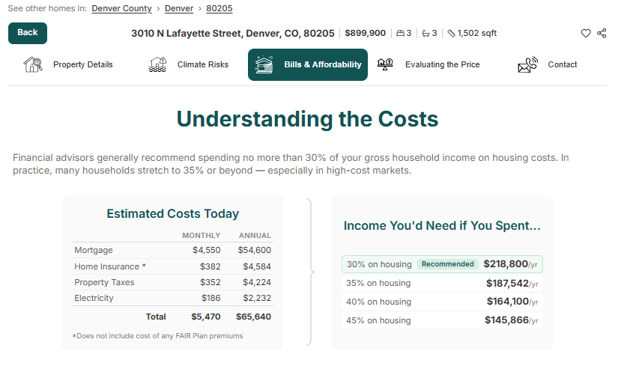
That spread — not the total — is the thing worth paying attention to before you buy.
What Do These Rising Costs Actually Determine?
It's not a budgeting inconvenience. The pace these costs rise is what separates "affordable to buy" from "affordable to stay."
Qualifying for a mortgage answers one question: can you close on this home today. It doesn't answer a different, equally important one: can you still comfortably afford it in three years, or five, once the lines that move — insurance and electricity especially — have moved. A budget built only around today's numbers can look perfectly reasonable at closing and get genuinely tight a few years in, not because anything went wrong, but because the fastest-moving costs did exactly what they were already doing before you bought. Some of that is within a homeowner's control after closing — resilience upgrades and energy-efficiency improvements can slow the growth of both insurance and utility costs over time — but that's a project for after you own the home, not something a budget built before you buy can lean on.
How Do You See These Scenarios Before You Own the Home?
A buyer can model different growth-rate scenarios for a specific property before making an offer, instead of accepting today's snapshot as the only picture.
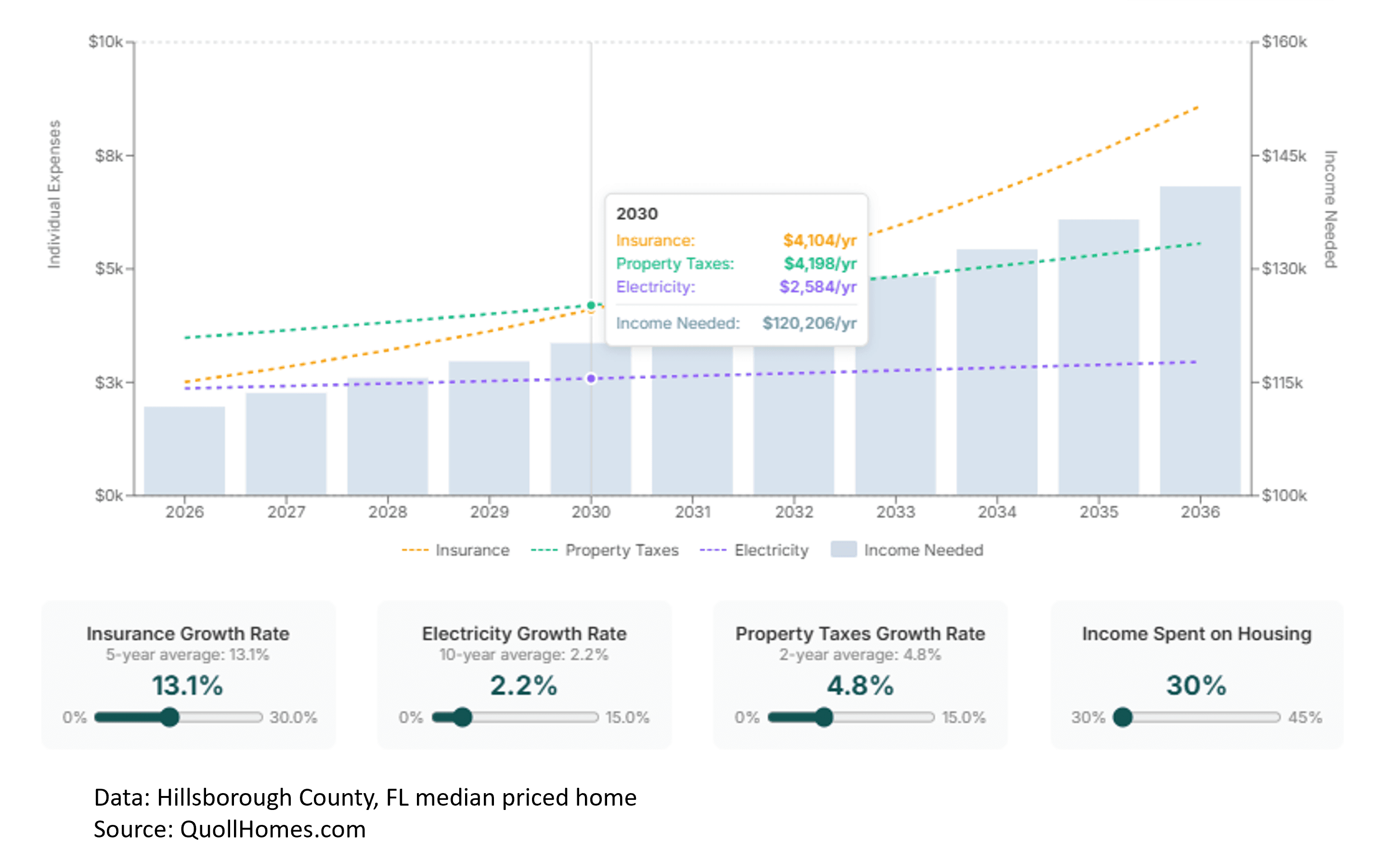
This is the same tool that shows the day-one breakdown above, extended forward. Instead of a single number, it shows what happens to that number if insurance keeps climbing at its recent pace, or slows down, or if electricity grows faster than expected — on the actual property being considered, not a generic estimate. That's the difference between hoping a budget holds up and actually checking whether it will.
Model your own scenario at QuollHomes.com.
Frequently Asked Questions
Why do insurance and utility costs rise faster than the mortgage payment?
A fixed-rate mortgage payment is set at closing and doesn't change. Insurance and utility costs aren't fixed — they're re-priced regularly based on risk, claims, and infrastructure costs, which is why they can rise meaningfully year over year while the mortgage stays flat.
How much can rising costs actually affect whether I can afford to stay in a home?
Enough to matter. A home that's comfortably affordable at closing, based on today's insurance and utility numbers, can become genuinely tight within a few years if those costs rise faster than income does — which is why modeling the trend matters as much as checking the current total.
Can I see how a specific home's costs might change before I make an offer?
Yes. QuollHomes.com's affordability tool shows a property's estimated costs today and lets you model how they could change over the next 10 years, before you make an offer.
Read next: Home Buying Cost Breakdown · What's the Actual Cost of Buying a Home in 2026? · How Rising Insurance Costs Are Quietly Changing Mortgage Qualification
Sources: None cited — this post deliberately teaches a way of thinking about cost variability using Quoll's illustrative tool output, rather than external statistics.