

The mortgage payment is only one line on the actual cost of owning a home. Property taxes, insurance, utilities, and (in many communities) HOA fees add up separately — and insurance and utilities are the two lines rising fastest, increasingly driven by climate risk rather than general inflation. Here's the full list to check before you make an offer.
Qualifying for a mortgage tells a lender what you can borrow. It doesn't tell you what it actually costs to keep living in a home once you're in it — and that's a different, usually larger, number made up of several separate costs most listings don't show.
What Are the Actual Costs Beyond the Mortgage Payment?
Beyond the mortgage, four categories recur on nearly every home: property taxes, homeowners insurance, utilities, and, for many properties, HOA fees.
Most mortgage calculators only compute principal and interest, so it's easy to budget off that number and assume it's the whole picture. Property taxes are usually the most predictable of the four — set by the local jurisdiction, billed annually or built into an escrow payment, and rising gradually with assessed value. Utilities cover electricity, gas, water, and often internet — routine, but easy to underestimate for a home larger or older than whatever the buyer's used to paying for. HOA fees apply only where a property has one, but where they do apply, they cover shared maintenance, amenities, and increasingly, the community's insurance costs. Homeowners insurance is the one buyers most often estimate from a rough percentage rule rather than an actual quote for the actual property — which is exactly where the estimate and the real number tend to diverge.
Which of These Costs Is Actually Growing the Fastest?
Insurance and utilities are growing faster than property taxes or general inflation, and both are increasingly tied to climate risk at the specific property, not a generic cost-of-living increase.
On the utility side, the U.S. Energy Information Administration's May 2026 Short-Term Energy Outlook puts the national average residential electricity price at 18.2 cents per kilowatt-hour in 2026 — nearly 5% higher than 2025. That's part of a longer run-up: EIA's annual data shows the national average climbing more than 31% since 2020, driven by grid modernization costs, extreme-weather-related infrastructure damage, and rising demand.
On the insurance side, Insurify's 2026 Insuring the American Homeowner Report projects the national average homeowners premium will reach $3,057 by the end of 2026, a 4% increase, following a 12% jump in 2025. Premiums are up roughly 46% since 2021 — about three times the rate of inflation over the same stretch.
For context on what "outpacing inflation" actually means here: the Bureau of Labor Statistics' Consumer Price Index shows overall consumer prices up about 22% since 2021, and nominal wages have grown at roughly that same pace over the same period, per BLS data — meaning the typical paycheck has mostly kept up with the general cost of living over the longer stretch. Insurance hasn't. Premiums are up 46% since 2021 — more than twice the rate of both inflation and wage growth over the identical period.
The same gap shows up even over just the past year, and it gets worse from here. Electricity prices are on track to rise nearly 5% in 2026, against overall inflation of 3.4% over the same trailing 12 months, according to BLS's most recent reading — electricity outpacing inflation in the short term too, not only over the longer run. And wages haven't kept up recently the way they did earlier in the stretch: BLS's Real Earnings report shows inflation-adjusted average hourly earnings actually fell 0.2% from July 2025 to July 2026. That's the compounding part a buyer really needs to understand — it's not just that a dollar buys less than it used to. There are fewer real dollars to begin with, at the same time insurance and electricity are both climbing faster than the general cost of living.
Neither insurance nor utilities behaves like property taxes, which move gradually and predictably. Both behave more like a variable that can shift meaningfully year to year, and both are increasingly a function of a property's specific climate exposure rather than a nationwide cost-of-living trend.
How Do You Get These Numbers for a Specific Home, Not Just a National Average?
A national average tells you the trend. It doesn't tell you what a specific property will actually cost — that takes a property-level breakdown, not a rule-of-thumb percentage.
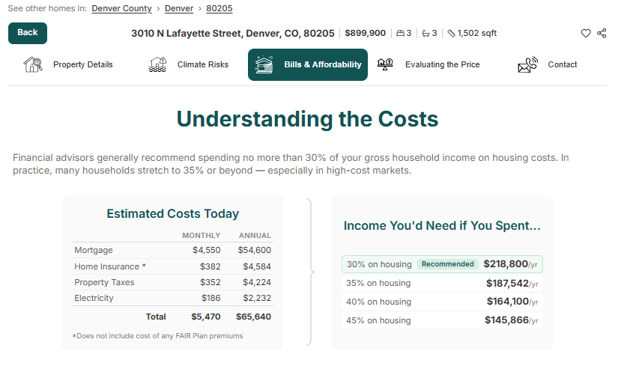
That's what QuollHomes.com is built to show — the actual monthly cost of owning a specific home, broken into each of these lines individually, not folded into a single estimated payment. The national trend explains why insurance and utilities deserve real attention instead of a rough guess. The property-level number is what actually determines whether a specific home fits a specific budget.
Try the cost breakdown at QuollHomes.com.
Frequently Asked Questions
What costs are included in the actual cost of owning a home, beyond the mortgage?
Property taxes, homeowners insurance, utilities, and — for properties that have one — HOA fees. Together with the mortgage payment, these make up the full monthly cost of ownership.
Why are insurance and utility costs rising faster than other homeownership costs?
Both are increasingly driven by climate-related factors — insurance by rising disaster-related claims and rebuilding costs, utilities by grid modernization and infrastructure damage from extreme weather — rather than by general inflation, which is why they're growing faster than more predictable costs like property taxes.
How can I see the actual cost breakdown for a specific home before I make an offer?
QuollHomes.com shows the estimated monthly cost of owning a specific home — mortgage, insurance, property taxes, and utilities — broken out as individual line items, before you make an offer.
Read next: What's the Actual Cost of Buying a Home in 2026? · Building a Real Home-Buying Budget · How Rising Insurance Costs Are Quietly Changing Mortgage Qualification
Sources: U.S. Energy Information Administration, Short-Term Energy Outlook (May 2026) · Insurify, 2026 Insuring the American Homeowner Report · U.S. Bureau of Labor Statistics, Consumer Price Index (CPI-U), Employment Cost Index, and Real Earnings report (July 2026)