
An insurance desert doesn't appear overnight — it starts with options narrowing. In New Orleans and Houston, compounding climate risks are colliding with standard-policy exclusions, forcing buyers into three separate policies instead of one. That's not a Florida problem. It's what a desert looks like as it forms.
Most buyers assume homeowners insurance is one policy that covers the house. In some markets, it structurally isn't. That gap — between what buyers assume and what's actually true — is exactly where a buyer's control over their own costs starts to narrow.
What Does It Mean When Insurance Options Start to Narrow?
In markets with compounding climate risk, standard homeowners insurance doesn't cover everything. Buyers end up piecing coverage together from multiple policies instead of one.
The mechanism is straightforward once you see it. A property exposed to hurricane wind, inland flooding, and a third compounding peril all at once carries what's sometimes called triple-threat risk — three distinct hazards, each requiring its own coverage decision. In 19 hurricane-coast states, insurers commonly build a separate, often steep deductible into standard policies specifically for hurricane and windstorm damage — a real cost buyers don't see coming, since it only applies after a storm, not on the declarations page most people actually read. In the highest-risk stretches of the Gulf Coast, some insurers go further and exclude wind coverage from the standard policy entirely, which means a buyer there isn't choosing whether to add a separate windstorm policy. They're required to, on top of a separate flood policy, on top of the standard homeowners policy underneath both. In that scenario it's three premiums instead of one, each moving independently, each capable of rising on its own schedule regardless of what the other two are doing.
Cotality estimates roughly 180,000 single-family homes nationally carry this full triple-threat exposure. That's not a niche edge case. It's a specific, identifiable slice of the housing market where "get homeowners insurance" quietly turns into a multi-part project most buyers never see coming until they're already under contract.
Where Is This Actually Happening — and Is It Really Not Just Florida?
New Orleans and Houston are two of the clearest examples of this exposure at scale, and neither one is in Florida.
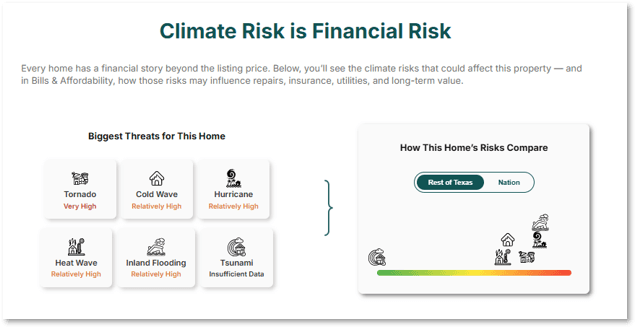
In the New Orleans metro, 29,317 homes carry triple-threat exposure — 6.8% of the metro's entire housing stock, facing hurricane wind, inland flooding, and hurricane-driven flood together. Houston's number is close in raw count — 23,602 homes — but represents a much smaller share of a much larger market: just 1.1% of its housing stock, not a smaller problem so much as a bigger denominator. The specific mix of risk looks different city to city, too. Pull up a real Houston listing on QuollHomes.com and the property's own Climate Risk profile — built on FEMA's National Risk Index — shows tornado risk rated "Very High," with hurricane, heat wave, and inland flooding all rated "Relatively High." That's a different risk fingerprint than New Orleans's hurricane-and-flood-dominated exposure, even though both cities show up as major triple-threat markets nationally. Both Louisiana and Texas are among the 19 states with mandated hurricane-deductible structures described above. This isn't a story about one state's insurance market being uniquely broken, or even about one specific combination of perils. It's a story about how differently climate risk compounds depending on where you are — and that variation doesn't respect state lines.
What Happens If This Trend Keeps Going?
As private insurance options keep narrowing in a market, a buyer's control over their own costs narrows right along with them — and in the most extreme cases, those options can evaporate entirely.
This has already happened in specific markets, where private insurers have withdrawn altogether and the only coverage left is a state-backed plan of last resort — a FAIR Plan. What triple-threat risk and windstorm exclusions look like in the early stage, a full-scale insurer exit looks like at the far end of the same trend. If you're evaluating a market where this pattern is showing up, it's worth understanding both stages, not just this one — see our guide to what it means when a property is only insurable through a state FAIR Plan.
There's an even sharper edge worth knowing about if you have a mortgage: FAIR Plans themselves aren't a guaranteed backstop. In high-demand periods, some have been swamped with new applications and real delays getting coverage in place. If a mortgaged homeowner's insurance lapses in the gap — whether waiting on a FAIR Plan or anything else — the lender is required to step in and buy coverage on the homeowner's behalf, called force-placed or lender-placed insurance. It typically costs several times a normal policy and protects only the lender's financial interest in the loan, not the homeowner's belongings or living expenses. It's a genuinely worse outcome than either a standard policy or a FAIR Plan, and it's the kind of thing worth knowing exists before you're the one waiting on hold.
The point of understanding any of this before you're deep into a deal is that it doesn't have to stay invisible. QuollHomes.com shows the real insurance picture on a specific property — not a state average, not a headline about "the Florida crisis" that may or may not apply to the address you're actually considering — before you make an offer.
See what this looks like on a real listing at QuollHomes.com.
Frequently Asked Questions
What is a "home insurance desert"?
It describes a market where private insurance options for a property have narrowed significantly — from standard policies excluding key perils, all the way to insurers withdrawing entirely and leaving only a state-backed plan of last resort as the remaining option.
Why would a home need three separate insurance policies instead of one?
In the highest-risk stretches of the Gulf Coast, some insurers exclude wind coverage from the standard policy entirely. That leaves a buyer needing a standard policy, a windstorm policy, and a flood policy separately, each with its own premium. Even outside those areas, 19 hurricane-coast states build a separate hurricane deductible into standard policies — a real cost, just a less extreme version of the same underlying problem.
Is this only a problem in Florida?
No. New Orleans and Houston both show significant triple-threat exposure, and Louisiana and Texas are both among the 19 states with mandated hurricane-deductible structures — with the highest-risk Gulf areas going further into full windstorm exclusions. It's a pattern tied to where specific perils overlap geographically, not to any one state.
How can I check whether a specific home has this risk before I make an offer?
QuollHomes.com shows the real insurance and climate risk picture for a specific property, before you make an offer — not a regional average or a headline that may not apply to that exact address.
Read next: What It Means When a Property Is Only Insurable Through a State FAIR Plan · Is Climate Risk Now a Bigger Price Factor Than Interest Rates? · How to Read a Property's Climate Risk Score Before You Fall in Love With It
Sources: Cotality ("The Peril Premium") · The Zebra, U.S. News, Smart Home America (19-state windstorm-deductible structure) · Consumer Financial Protection Bureau (force-placed insurance) · QuollHomes.com (Climate Risk profile, FEMA National Risk Index)