

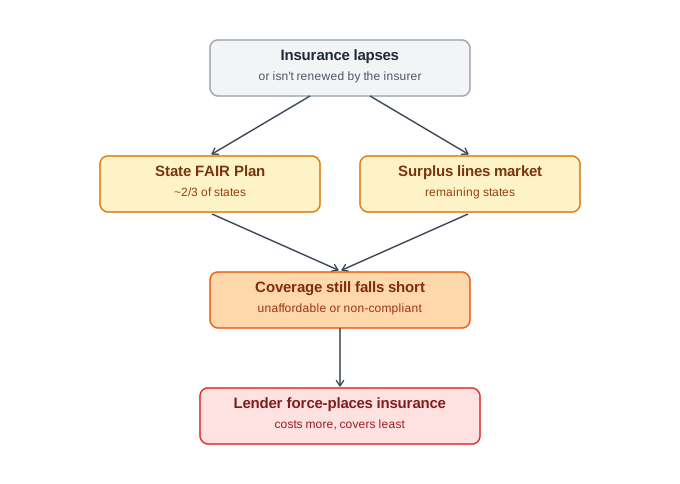
When homeowners insurance becomes unaffordable, there's a documented chain: a state FAIR Plan or the surplus lines market steps in as backup, costing more and covering less — and if that's still not enough, the lender force-places insurance, typically at about twice the cost and protecting only the lender. Each step costs more than the one before it.
What Actually Happens When Homeowners Insurance Becomes Unaffordable?
Climate risk is the reason this chain exists in the first place. Severe weather and major disasters concentrate in specific regions, and insurers price coverage by spreading that risk across everyone in an exposed area — a homeowner in a wildfire zone or hurricane corridor isn't just paying for their own risk, they're collectively absorbing the region's. When an area gets reclassified as high-risk, the math changes for the insurer as much as the homeowner: claims costs climb, reinsurance gets more expensive, and some insurers pull back or leave the market entirely rather than keep writing policies there. Research tracking over 74 million premiums found that between 2014 and 2024, the gap between what the riskiest and safest areas pay for insurance grew from about 30% to more than 55% — a sign of how real and how fast this repricing has moved. (We cover that research in more depth in "Your Credit Score Affects Your Insurance Rate Too.")
Most people think of rising insurance costs as just a bigger bill. For a growing number of homeowners, it's the first step in a longer, more expensive chain.
Here's what that chain looks like once private coverage becomes unaffordable or gets non-renewed. In roughly two-thirds of states — 33 plus Washington, D.C. — the backup is a state FAIR Plan, an insurer of last resort that typically costs more and covers less than the policy it replaces. In the rest, the fallback is the surplus lines market, which comes with its own higher costs and fewer built-in protections. If that backup coverage is still unaffordable, or doesn't meet what the mortgage requires, the lender steps in directly with force-placed insurance: coverage that protects only the lender's stake in the property, covers less than either prior option, and typically costs about twice as much as a standard policy, according to the Consumer Financial Protection Bureau — and in the most severe cases, reportedly up to ten times as much. Each step in the chain costs more and protects less than the one before it. That's not a coincidence. It's the structure of what happens when private options run out.
How Does This Actually Affect Whether You Can Keep Your Mortgage?
Each step in this chain adds cost without adding to what a homeowner can actually spend — squeezing the same budget the mortgage was originally approved against.
This isn't a fringe scenario, and regulators have had to respond to it directly. In February 2024, Fannie Mae updated its Servicing Guide to require servicers verify a homeowner's insurance coverage annually — a real tightening of oversight, though about verification duties rather than a push toward force-placement itself. A broader, stricter update was planned for later that year but got postponed after industry pushback. Then, in March 2026, the Federal Housing Finance Agency directed Fannie Mae and Freddie Mac to actually loosen several of those same insurance requirements — including retiring a rule requiring documented replacement-cost coverage — citing "skyrocketing" insurance costs directly as the reason. Regulators tightened the rules, then had to walk part of it back because the underlying insurance market couldn't support them — a genuinely systemic problem, not a fringe one, given that federal housing regulators are actively adjusting policy around it in real time. Force-placed premiums typically aren't billed separately, either way — they get added directly into the mortgage payment through escrow, which means a homeowner who was current on their mortgage the month before can suddenly owe substantially more the month after, through no change in their own financial situation. For a household already budgeting close to the edge, that kind of sudden increase is exactly the sort of thing that turns a current mortgage into a delinquent one.
How Do You Avoid Starting Down This Chain in the First Place?
Seeing a property's actual climate risk and insurance picture before you buy is what keeps a buyer from ever needing the backup options this chain runs through.
The chain above starts with an insurance problem — a policy that's unaffordable or gets non-renewed — and that problem is often visible well in advance, tied to a property's specific climate exposure rather than something that appears without warning. QuollHomes.com shows that climate risk picture directly, on the actual property being considered, before an offer is made.
See a property's climate risk at QuollHomes.com.
Frequently Asked Questions
What is force-placed insurance?
It's coverage a mortgage lender purchases on a homeowner's behalf when the homeowner's insurance lapses or doesn't meet the mortgage's requirements. It protects only the lender's financial interest in the property, not the homeowner's belongings or liability, and typically costs about twice as much as a standard policy, according to the CFPB.
Why would my insurance cost jump dramatically if my policy lapses, even if it's not my fault?
Because the replacement coverage that steps in — a state FAIR Plan, the surplus lines market, or ultimately lender force-placed insurance — is structured to cost more and cover less at each step, regardless of why the original policy lapsed.
How does this affect my ability to keep up with my mortgage payments?
Force-placed insurance premiums typically get added directly into the mortgage payment through escrow, which can increase what's owed each month without any change in the homeowner's finances — a real risk factor for falling behind.
How can I avoid ending up in this situation in the first place?
Understanding a property's climate risk before you buy is the clearest way to avoid it. QuollHomes.com shows that risk picture directly, before you make an offer.
Read next: What It Means When a Property Is Only Insurable Through a State FAIR Plan · What "Home Insurance Deserts" Are · Your Credit Score Affects Your Insurance Rate Too
Sources: Fannie Mae Servicing Guide Announcement SVC-2024-01 (February 2024) · FHFA news release, "Fannie Mae and Freddie Mac Revise Insurance and Condo Requirements" (March 18, 2026) · Consumer Financial Protection Bureau, consumer advisory on force-placed insurance · Keys, Benjamin J. and Philip Mulder, "Property Insurance and Disaster Risk," NBER Working Paper 32579