

Different "average home insurance" rankings can disagree sharply with each other — sometimes by more than double for the same state in the same year — because each source defines "average" differently. That's not necessarily a mistake; it's a sign no single number can tell you what a specific home will actually cost to insure. Check the property, not just the ranking.
Example — one widely shared version of this list, from Kiplinger (based on NerdWallet data, current as of August 2026):
Rank | State | Avg. annual premium |
|---|---|---|
1 | Oklahoma | $7,255 |
2 | Nebraska | $6,015 |
3 | Kansas | $5,455 |
4 | Arkansas | $4,955 |
5 | Texas | $4,915 |
6 | Mississippi | $4,445 |
7 | Alabama | $4,285 |
8 | Tennessee | $4,220 |
9 | South Dakota | $3,965 |
10 | Colorado | $3,910 |
National average: $2,490. Source: Kiplinger, "These 10 States Have the Most Expensive Home Insurance in 2026," citing NerdWallet.
Before making an offer, it's natural to check how a state stacks up on one of the widely shared "most expensive states for home insurance" lists — and to treat a state that doesn't make the top of the list as one less thing to worry about. That instinct makes sense. It's also not entirely safe to rely on, and not for the reason most buyers would guess.
Why Don't Different "Average Home Insurance" Rankings Agree With Each Other?
They often don't. There's no single agreed-on definition of "average" — different sources choose different coverage amounts, different data (real quoted rates versus modeled estimates), and different carrier mixes, and each choice produces a different number for the same state in the same year.
Florida makes this easy to see, though the same pattern shows up almost anywhere you check. Four different sources currently report Florida's average annual homeowners premium as: $3,390, $4,329, $6,432, and $7,136 — all figures dated 2026, not a mix of old and new data. That's more than double, for the same state in the same year. None of these numbers is necessarily wrong. Each source has to pick a stand-in for "a typical home" and "a typical policy" before it can report a single figure at all, and those choices don't line up between providers — two use $400,000 in dwelling coverage, two use $300,000, and one prices real marketplace quotes instead of a modeled estimate. Every source is managing to its own version of the lowest common denominator: the simplest, most comparable stand-in it can build across 50 states. Useful for ranking states against each other. Much less useful for estimating what a specific home would actually cost to insure.
Even the most carefully built average is still a state-level number modeling one coverage amount — NerdWallet's, for instance, assumes $400,000. It doesn't know whether that figure is anywhere near what it would cost to rebuild the specific home under consideration, which is the number that determines the bill.
Why Doesn't California Rank Near the Top of Insurance-Cost Lists Despite High Wildfire Risk?
Because California's statewide average premium is actually below the national number — not because the risk is low, but because a large share of the real cost of insuring a high-risk home there is split across separate policies that a single "average premium" doesn't add together.
NerdWallet puts California's average homeowners premium at $2,230 a year, below the $2,490 national figure. But homeowners in wildfire-exposed areas who've lost standard coverage are often insured through the California FAIR Plan instead — a policy that covers fire and smoke only. The FAIR Plan's site states plainly that it doesn't offer anything beyond that: homeowners need a separate Difference-in-Conditions (DIC) policy, from a different carrier, to cover theft, water damage, and liability, plus a third, separate policy for earthquake coverage. Three premiums, not one, and the standard-market survey behind the state average isn't built to add them up.
The stakes are already showing up at the closing table. The California Association of Realtors' Annual Housing Market Survey (roughly 3,000 responding members) found 13% reported a transaction falling out of escrow over insurance affordability in 2024, up from 6.9% in 2023.
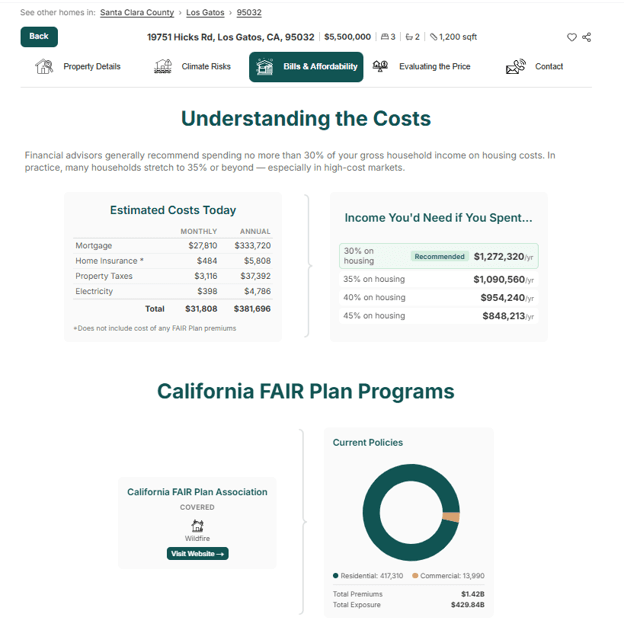
This home in CA may require additional insurance beyond a standard policy estimate for its high fire risk.
Is Florida's Insurance Price a Warning Sign Instead of a Discount?
Florida already showed up above as an example of how much rankings can disagree with each other. Here's a specific reason that disagreement matters for Florida in particular: its state-backed insurer is priced well below the actual cost of the risk it covers, by design, and that's a different problem than a coverage-amount mismatch.
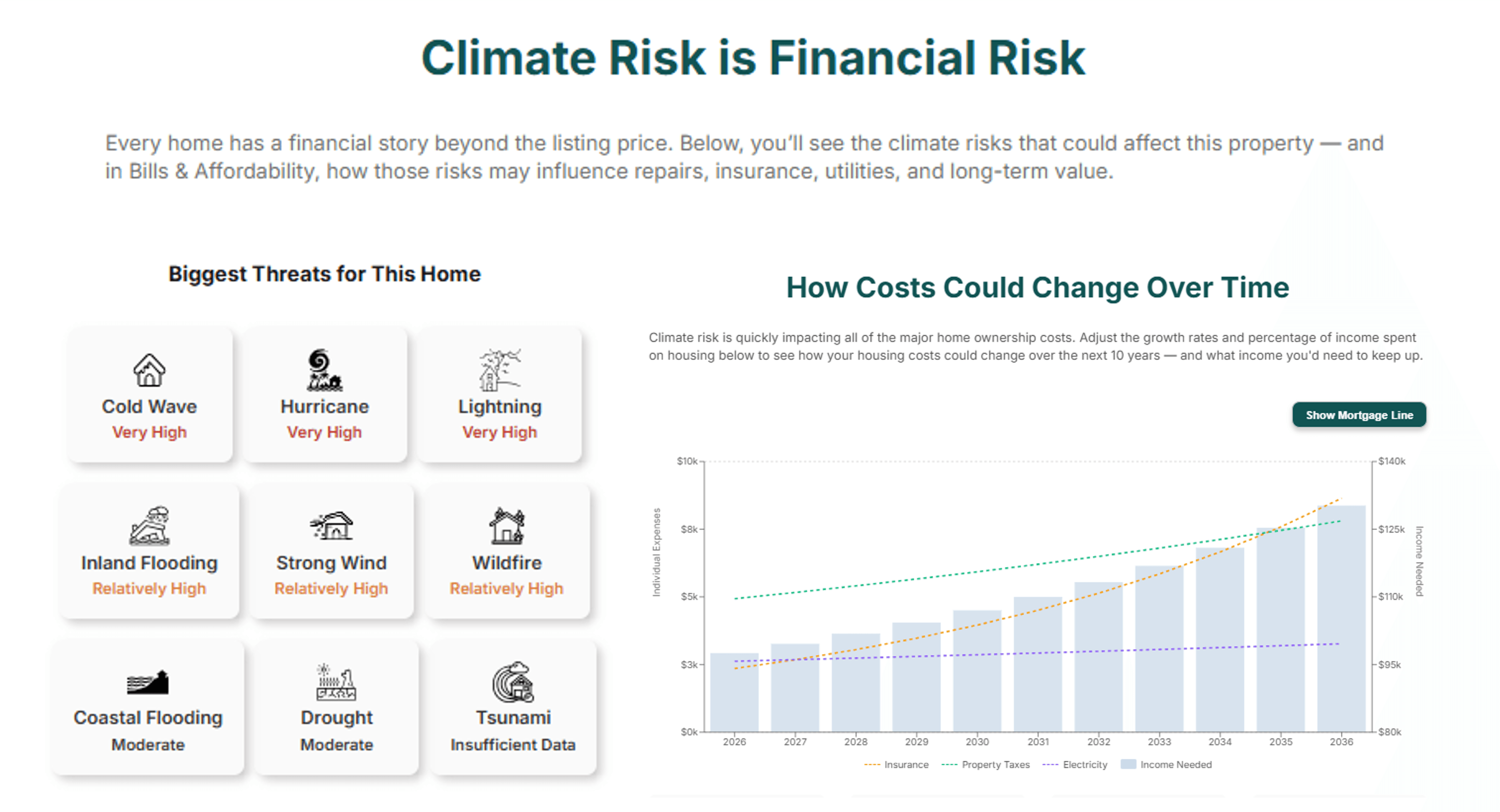
Going by NerdWallet's figure ($3,390 a year), Florida's modeled average premium doesn't crack the top 10 — it sits below Colorado's $3,910 threshold for this year's list. Citizens, Florida's insurer of last resort, covers a large share of the state's highest-risk homes, and CEO Tim Cerio told a Florida House committee plainly: "Insurance companies must charge an actuarially sound rate. We're not doing that. We're below that... our customers... are getting, it's fair to say, subsidized insurance." One industry estimate puts Citizens' rates roughly 55% below actuarially sound levels. That gap doesn't make the hurricane risk smaller. It just moves the bill to whenever the next major storm season forces a reckoning, instead of spreading it into today's premium.
What Should You Actually Do With a State Insurance Ranking?
Use it to narrow down where to look, not to decide whether a specific home is safe to buy. A state ranking answers "how does this state compare to others, for a standard policy on a standard home." It was never built to answer "what will it cost to fully insure this home" — that depends on the property, its rebuild cost, and the specific policies available where it sits, not the state average.
See a closer, local-area insurance and risk estimate for your target market at QuollHomes.com.
Frequently Asked Questions
What are the most expensive states for home insurance?
It depends which source you check. Rankings that model a standard policy (like NerdWallet's, at $400,000 in dwelling coverage) currently put Oklahoma, Nebraska, and Kansas near the top. Rankings built from real marketplace quotes rather than a modeled estimate often rank states like Florida far higher instead. There's no single correct answer — a reason to check more than one list before deciding what a state's risk looks like.
Why doesn't my state showing up on a "most expensive insurance" list mean I'm not at risk?
A low ranking can reflect a genuinely lower-risk state, or it can reflect risk that's split across policies the ranking doesn't count, or a state-backed insurer pricing below the real cost of the risk. The ranking alone can't tell you which one you're looking at.
How much home insurance coverage do I actually need to rebuild my home?
Enough to cover current rebuilding costs, labor, materials, and permitting, not the purchase price or the tax-assessed value, which are both frequently different numbers. A local contractor estimate or a property-specific tool is a more reliable guide than a national average.
Should I trust a state insurance ranking when I'm shopping for a home?
Treat it as a first pass, not a final answer. It's a reasonable way to compare states broadly, then look at what full coverage would cost for the specific home under consideration before relying on it further.
Read next: Home Insurance Deserts · What It Means When a Property Is Only Insurable Through a State FAIR Plan · Growing Fast, Getting Riskier: What That Tradeoff Actually Costs You
Sources: Kiplinger ("These 10 States Have the Most Expensive Home Insurance in 2026") · NerdWallet · LendingTree · Insurify · Insurance.com · California FAIR Plan (cfpnet.com) · California Association of Realtors, Annual Housing Market Survey · Citizens Property Insurance Corporation