
In high-risk markets, deals are increasingly falling apart over insurance, not financing or appraised value. Climate risk drives that — it shapes a home's bills and long-term affordability directly, so knowing the risk before you offer lets you act on it: some insurers reward hardening and mitigation, or specialize in covering resilient homes others won't.
Buyers plan for the appraisal and the inspection as the things that can derail a deal. In high-risk markets, insurance is becoming the bigger risk, and it's the one nobody sets aside time for. It doesn't show up on the standard closing checklist the way a low appraisal or a failed inspection does, which is exactly why it catches buyers late — often after they've already waived contingencies they didn't realize were protecting them.
How Often Do Insurance Problems Actually Kill a Home Sale?
More often than most buyers expect, and it's not a California-only pattern.
A national survey of 1,100 homeowners by Insurance.com found that insurance problems touched nearly half of the people who'd recently bought or sold a home — 47% — and for 21% of them, the deal itself collapsed over insurance cost: 12% of buyers backed out, 9% of sellers lost a sale, both specifically because of what insurance turned out to cost or whether it was available at all.
That's a national number, but it lines up with what's happening in especially high-risk markets directly: in California, 13.4% of REALTORS® reported in 2024 that a transaction fell out of escrow because a buyer couldn't secure affordable insurance — nearly double the 6.9% rate from the year before, according to the California Association of REALTORS®' 2024 Annual Housing Market Survey.
What Actually Goes Wrong With Insurance Mid-Contract?
Three specific failure modes account for most of it, and none of them are financing problems in disguise.
An insurer declines to write a policy at all. This happens most often on properties in the highest wildfire, flood, or wind-exposure zones, and it can surface only after the buyer is already under contract and an agent starts shopping quotes. When it happens, the property may fall back on a state FAIR Plan — a last-resort, often more limited and more expensive option covered in more detail in our guide to FAIR Plan coverage.
A quote comes back far above what the buyer budgeted. A pre-approval is based on an estimated insurance cost, not a locked-in one. When the real quote lands thousands of dollars higher, it can push the monthly payment past what the buyer actually qualifies to carry.
Coverage excludes the exact risk the buyer needed covered. A policy that technically satisfies the lender's insurance requirement isn't the same as a policy that covers wildfire, flood, or wind damage specifically — buyers sometimes don't find out the gap exists until after closing.
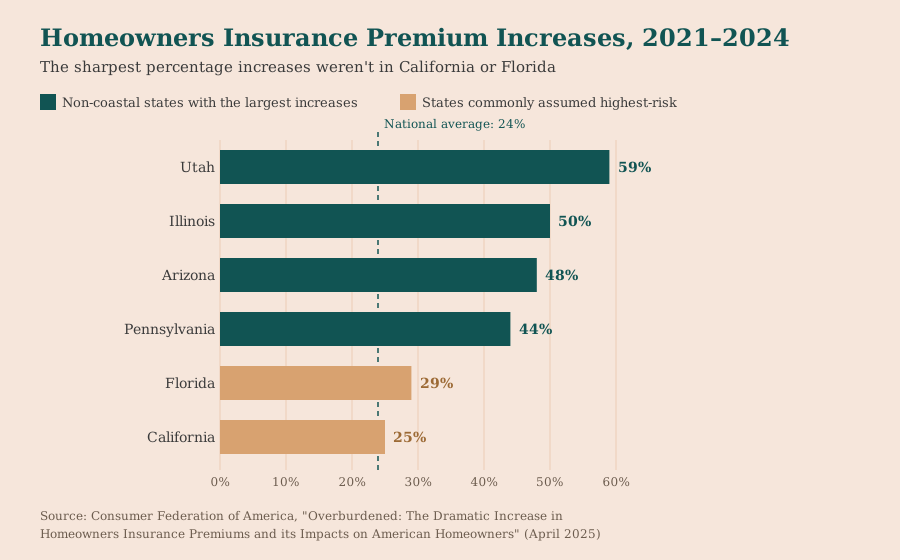
None of this is limited to the states people assume. A Consumer Federation of America report, Overburdened: The Dramatic Increase in Homeowners Insurance Premiums and its Impacts on American Homeowners (April 2025), found that premiums rose in 95% of U.S. ZIP codes between 2021 and 2024, with the sharpest percentage increases in Utah (59%) and Illinois (50%) — not California or Florida. As CFA's Director of Housing, Sharon Cornelissen, put it, the trend is "deepening the housing crisis from Salt Lake City to New Orleans and beyond." A buyer shopping in a market that doesn't fit the usual "high risk" mental picture can still run into all three of the failure modes above.
How Do You Protect a Deal From This Before You're Under Contract?
The starting point is the same one that runs through almost everything on this site: know the actual risk on that property before you write the offer, not after.
Knowing that risk does more than protect against surprise. Once a buyer knows what's driving a property's exposure — wildfire, flood zone, wind rating, hail frequency — that knowledge points toward which insurers are worth calling, because the market isn't uniform. Some carriers specifically reward homes that have been hardened against the risk they're most exposed to, or specialize in writing coverage for resilient properties that other insurers decline outright.
In California, Mercury Insurance offers wildfire mitigation discounts of up to 30% on the wildfire-peril portion of a policy's premium for homes with defensible space, hardening features like ember-resistant vents, or an IBHS Wildfire Prepared Home certification. In Florida, Kin Insurance offers wind mitigation credits, including FORTIFIED construction credits, for homes with hurricane-resistant features — and it's notable for being one of the newer insurers still willing to write policies in higher-risk Florida zones that some larger, longer-established carriers have pulled back from.
Neither insurer is the only option in its state, and mitigation credits vary by property and documentation. What matters is running that search before the offer goes in, rather than scrambling to find coverage once a contingency clock has already started.
Frequently Asked Questions
Can a home sale really fall through because of insurance?
Yes. A national survey found that 21% of recent home buyers and sellers had a transaction collapse specifically over insurance cost, and in California — one of the highest-risk markets — 13.4% of Realtors reported the same thing happening in 2024 alone, nearly double the year before.
What's an insurance contingency, and do I have one?
An insurance contingency gives a buyer a set window to confirm coverage on a property, with a way out if workable coverage can't be found. Whether you have one depends on your state and contract: some standard contracts include a dedicated insurance deadline, while others leave insurance to another contingency or to none at all. Your real estate agent can tell you what yours includes.
Are there insurance companies that reward homes with wildfire or hurricane mitigation upgrades?
Yes — Mercury Insurance offers wildfire mitigation discounts in California for hardened, defensible-space properties, and Kin Insurance offers wind mitigation credits in Florida for hurricane-resistant features. Availability and discount amounts vary by property and insurer.
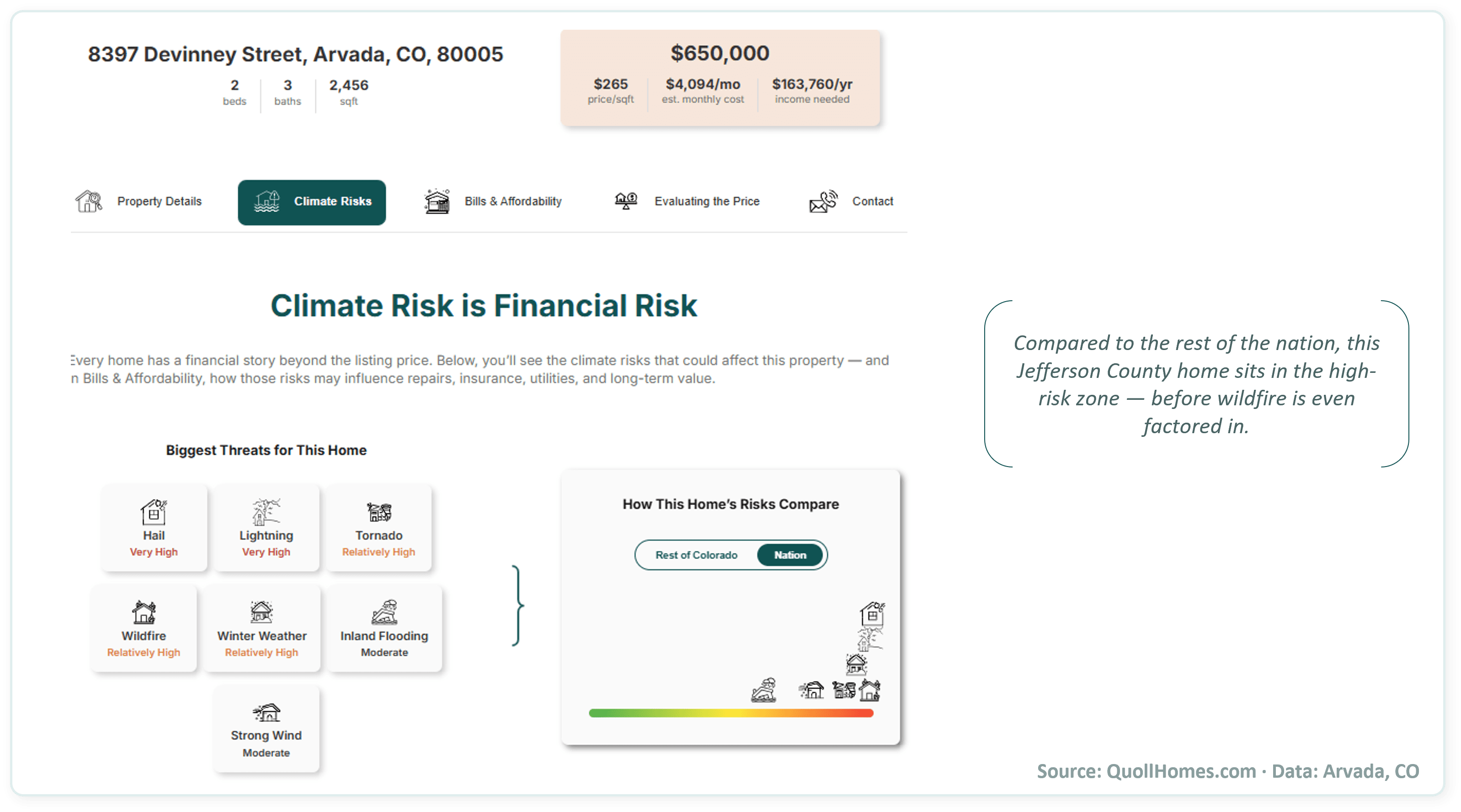
Before you finalize an offer, look at the risk and cost breakdown already on that property's QuollHomes.com page. It shows the climate risks behind its insurance estimate, which gives you something to check each insurer's quote against.
Related reading:
Why the House Itself Can Sink Your Insurance Quote
Should You Ask the Seller to Credit Future Insurance Increases?
Ask About These Resilience Upgrades Before You Buy — They Drive Your Insurance Cost