

Home insurance cost isn't fixed to a property's location — it's driven by specific mitigation features insurers recognize, separate from general maintenance. Asking about those features on a home you're considering, before you buy, can change the real cost of owning it. QuollHomes.com already shows the climate risk behind that question.
Buyers assume a home's insurance cost is just a fact about where it is and what it's worth. It isn't. Two houses on the same street, priced the same, can insure very differently — and the difference usually comes down to something a buyer can ask about before they're committed to the purchase, not something they just have to accept.
What's the Difference Between Home Maintenance and Mitigation Upgrades?
Maintenance keeps a home functioning. Mitigation upgrades reduce the risk an insurer is pricing — and only one of those reliably changes what a policy costs.
Fixing small issues, keeping systems running, staying ahead of wear: that's maintenance, and most homeowners already do it. It matters, but it doesn't move a premium on its own. Mitigation upgrades are different — they're the projects insurers recognize in higher-risk areas, and they're often the difference between a policy existing at all and a policy existing at a price a buyer can actually live with. A home can be immaculately maintained and still come with a high insurance quote, because maintenance and mitigation are answering two different questions: maintenance asks "is this home in good shape," and mitigation asks "how much risk this home is exposed to, and has anything been done about it."
For a buyer, that distinction matters immediately. A well-kept home with no mitigation work can cost meaningfully more to insure than a similarly priced home that has it — and a buyer who only asks general questions about a property's condition never finds that out.
Which Upgrades Do Insurers Actually Recognize?
It varies by peril, and insurers in high-risk states are already pricing several of them.
For wildfire, defensible space and hardening features like ember-resistant vents are the recognized categories — Mercury Insurance in California, for example, offers wildfire mitigation discounts of up to 30% on the wildfire-peril portion of a premium for exactly this kind of work. For hail, Class 4 impact-resistant shingles are an established industry rating (tested to UL 2218 standards) that many insurers recognize with a premium discount. For wind, impact-resistant or hurricane glass and wind-resistant roofing are recognized "wind mitigation" features — Florida Statute 627.0629 actually requires insurers to include actuarially reasonable wind mitigation discounts in their rate filings, and Kin Insurance is one of the carriers still willing to write policies in higher-risk Florida zones that reward this kind of work. For water damage and flooding, water leak detectors and sump pumps are recognized by carriers including USAA and Amica, which makes sense given that water damage and freezing are consistently among the most common homeowner claims, according to the Insurance Information Institute.
This isn't every upgrade an insurer might recognize — it's a starting list by peril, enough to know what to ask about. GetQuoll.com has the fuller, per-address version once a buyer knows which perils apply to a given property.
How Do You Find Out Which Upgrades Matter for a Specific House?
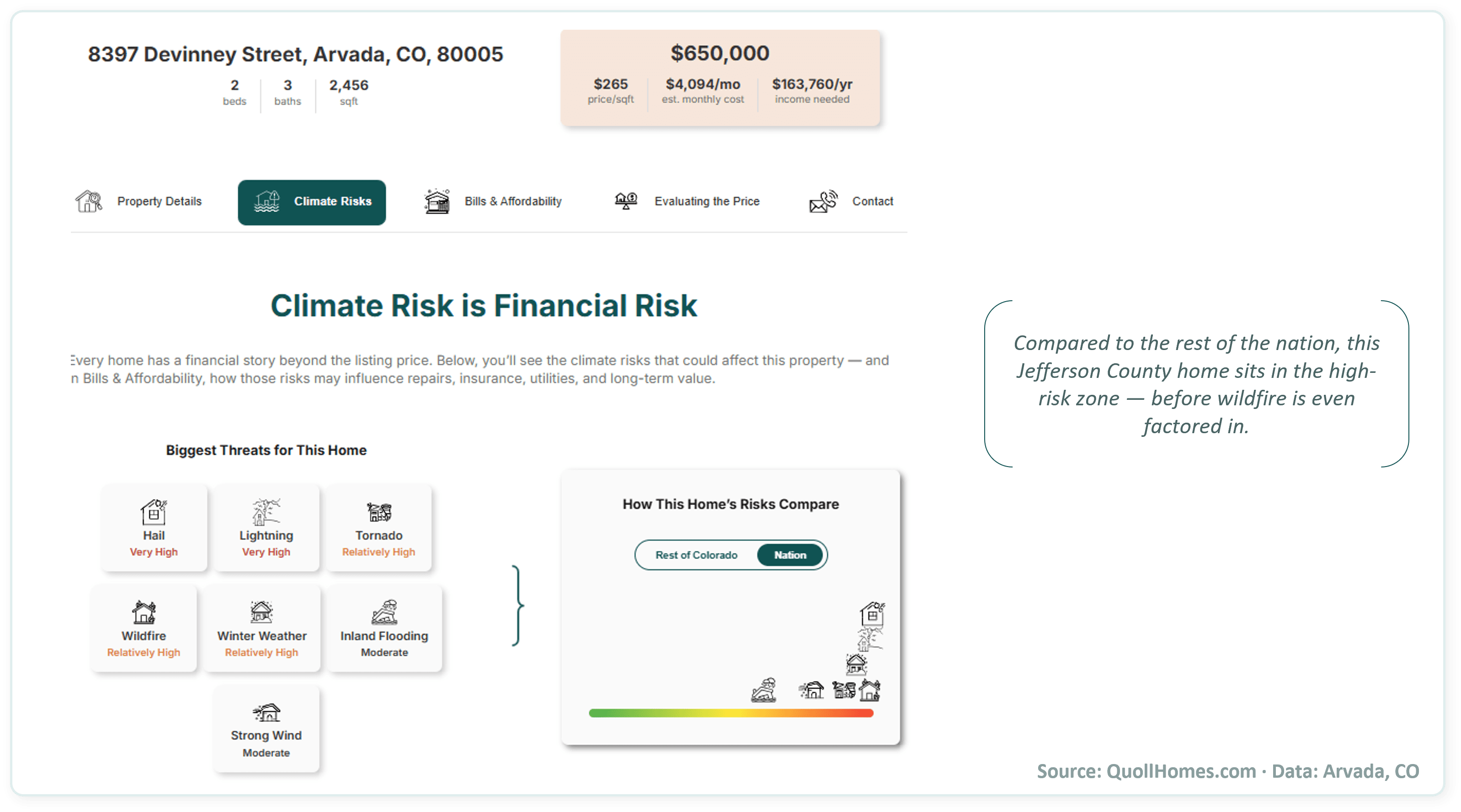
Start with the climate risk breakdown that's already part of looking at any property on QuollHomes.com — there's no separate report to go run first.
Once that breakdown shows which perils apply to this house — wildfire, wind, hail, flood, or some combination — the next step is asking direct questions: does this home have any of the mitigation features tied to those perils, and if not, would adding them change the quote enough to matter? A seller, a listing agent, or an insurer can usually answer that quickly once a buyer asks about that feature rather than "is insurance expensive here."
This same distinction matters past the purchase, too. An existing owner deciding where to spend money can use it the same way a buyer does: mitigation work moves the number that maintenance alone won't touch. Passive House principles show what mitigation-minded building looks like taken further — architect George Kontaroudis, AIA, LEED AP, CPHD, has documented a Passive House in Greece running on so little energy that the annual bill lands around what many households pay in a single month, through airtightness, insulation, high-performance windows, and heat-recovery ventilation adapted to the home's own climate rather than copied wholesale. A seller who's already done mitigation work has a similar opening in reverse: naming the upgrades in a listing, rather than a vague "energy efficient" label, gives a buyer something concrete to bring to their own insurance search. Both sides deserve fuller treatment elsewhere — this post only has room for the nod.
Frequently Asked Questions
What's the difference between home maintenance and mitigation upgrades?
Maintenance keeps a home functioning — fixing small issues, staying ahead of wear. Mitigation upgrades specifically reduce the risk an insurer is pricing, like defensible space for wildfire or impact-resistant glass for wind. Only mitigation reliably changes what a policy costs.
Can asking about resilience upgrades actually change my insurance quote before I buy?
Yes. Insurers recognize specific mitigation features with real discounts — up to 30% on the wildfire portion of a premium in some California programs, for example. Knowing which features a property has, or lacks, before making an offer changes what a buyer should expect to pay.
Do resilience upgrades matter for people selling a home too?
Yes — naming completed mitigation work in a listing gives buyers something concrete to bring to their own insurance search, rather than a vague efficiency claim. A full look at the seller (and ongoing owner) side of this deserves its own post.
Look at the climate risk breakdown already on QuollHomes.com for the property you're considering, then use it to ask targeted questions about mitigation — no extra step required.
Related reading:
Roof Age, Defensible Space, and Other Underwriting Details That Can Sink Your Insurance Quote — internal link pending, not yet built
Why Insurance Problems — Not Appraisals — Are Killing Deals in High-Risk Markets