

A special assessment isn't automatically a red flag. One tied to a storm or repair differs from one with no clear trigger — that usually means chronic underfunding. The real signal is the reserve study's percent-funded number (how much of what's needed is actually saved) and how often assessments recur, not the size of one bill.
Getting the paperwork is the easy part — the reserve study, the meeting minutes, the disclosure packet. What most buyers don't know is what a bad answer actually looks like once those documents are in hand, and whether one uncomfortable number means walk away or just ask a follow-up question.
Is This Assessment a One-Time Event, or a Symptom of Something Bigger?
An assessment tied to a specific, dateable cause — a named storm, a new law taking effect — carries different risk than one with no clear trigger at all; the second kind is usually chronic, not situational.
Some assessments have an obvious, dateable cause. Florida's Senate Bill 4-D, signed into law in 2022, requires milestone structural inspections and reserve funding for condo buildings three stories and up — a single legislative change that forced assessments onto buildings statewide, all tied to the same law and the same effective date. That kind of trigger is easy to check: does the notice cite a specific event, storm, or regulatory deadline? If so, it's more likely a one-time cost than a warning sign about how the HOA runs its finances day to day.
Most assessments don't come with that kind of clean explanation. Association Reserves — which has completed more than 100,000 reserve studies across all 50 states since 1986 — found in its 2026 industry analysis that most of the associations it works with are underfunded, and that a board tracking its numbers shouldn't be caught off guard by an assessment tied to ordinary wear and tear. When a notice doesn't point to a named event and instead references years of deferred maintenance or "catching up" on repairs, that's the chronic pattern, not a one-off.
What Does the Reserve Study's "Percent Funded" Number Actually Tell You?
The single most useful number in a reserve study is its percent-funded figure — how much of the mathematically ideal reserve balance an association actually has on hand right now.
Every reserve study should include a percent-funded figure: the association's actual reserve balance divided by its Fully Funded Balance, the computed value of how much the building's shared components have already deteriorated. Association Reserves, the firm behind the formula, treats it as the clearest single measure of reserve health. Its own industry data splits associations into three bands. Below 30% funded, the association is rated "weak" — deferred maintenance is common, and a special assessment is likely at some point. From 30% to 70%, it's "fair," a middle zone that still carries real risk worth watching closely. Above 70%, it's "strong," and outright special assessments become rare. Across the firm's own client base — more than 100,000 studies prepared since 1986 — 34% of associations currently fall in that weak, under-30% band, and only about a quarter are in the strong range.
A $500,000 reserve fund sounds like a lot until it's measured against what a building actually needs. The dollar amount alone doesn't tell you that; the percent-funded figure does. Most reserve studies list it plainly in the funding summary — look for the phrase "percent funded" or "fund status" near the front of the document, not buried in the component-by-component detail tables.
How Do You Spot a Pattern Instead of a One-Off?
Look at frequency over time, not just the size of one bill — one assessment in a decade is different from a building that's needed several in just a few years, or a reserve study that hasn't been updated in a while.
How often the reserve study itself gets updated is its own signal. Association Reserves found that associations updating their study at least every three years get roughly half as many new special-assessment recommendations as those updating only every five years — and associations that update annually see that rate drop even further. A reserve study that's several years old, sitting on top of an association that's already had more than one assessment, is a much stronger warning sign than either fact on its own. In practice, that means checking two dates side by side: when the reserve study was last updated, and how many special assessments show up in board minutes over roughly the same stretch of time.
Climate exposure changes how fast that clock runs. Buildings in higher wildfire, wind, or flood-risk areas tend to wear out faster and see insurance costs climb quicker, which pushes reserve requirements up faster than a stale study accounts for. Checking the property's own climate risk profile on QuollHomes.com is a quick way to gauge whether that's a live factor for this building, before deciding how skeptically to read its financial documents.
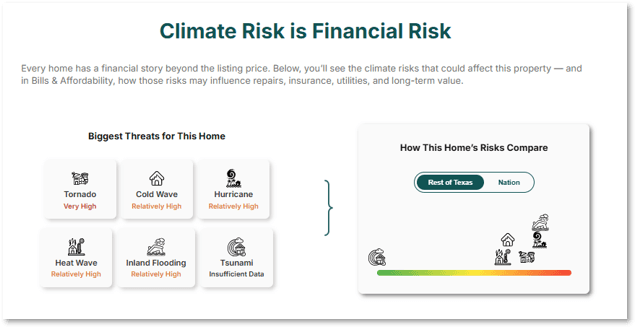
Check the QuollHomes climate risk profile for the address — higher exposure is a reason to read the reserve study and assessment history more skeptically, not a separate, unrelated check.
If you haven't gathered the reserve study, meeting minutes, or insurance details yet,
Frequently Asked Questions
What does "percent funded" mean in an HOA reserve study?
It's the association's actual reserve balance divided by the amount reserve specialists calculate it should have on hand today, given the age and condition of its shared components. Under 30% is considered weak, 30–70% fair, and 70% or above strong.
How do I know if an HOA has actually saved enough, not just that it has a savings account?
Don't look at the raw dollar amount — a $500,000 reserve fund can be plenty for a small building and dangerously short for a large one. Ask for the percent-funded figure specifically; that number accounts for the building's actual size and age, a flat balance doesn't.
Is every special assessment a red flag?
No. One tied to a specific, dateable cause — a storm, a new law taking effect — is a different risk than one with no clear trigger, which usually points to years of underfunding rather than a single event.
How does a property's climate risk connect to its HOA's financial health?
Buildings in higher-risk areas tend to wear out and get more expensive to insure faster, which can make an old reserve study go stale sooner than the board realizes.
Related reading: